
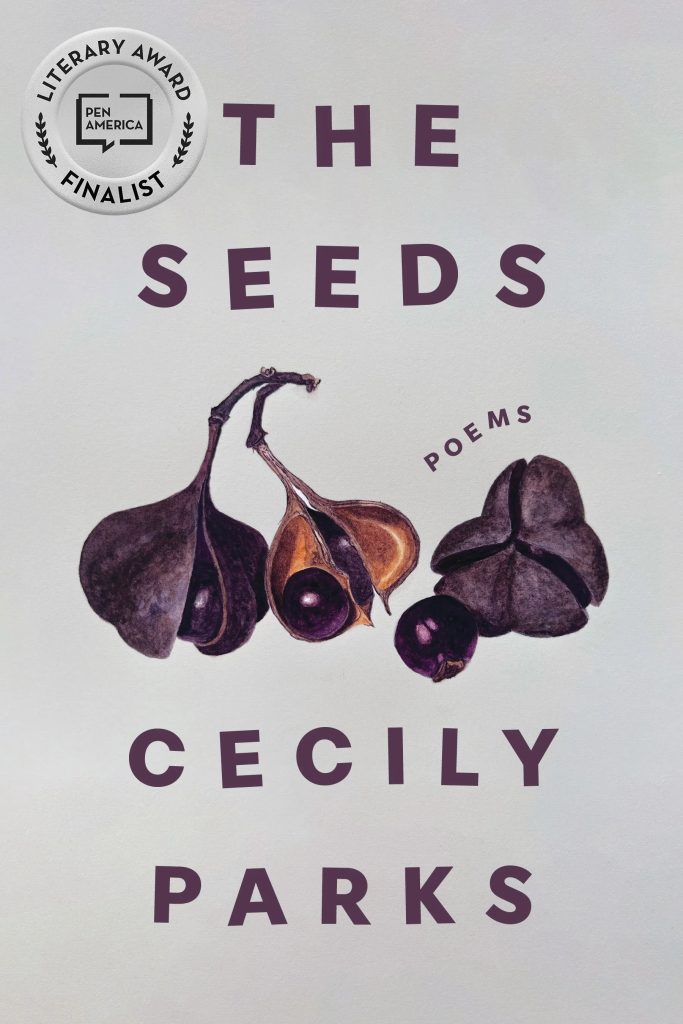
The Dirt that Grew the Flower: Ecopoetics & the Domestic in Cecily Parks’s The Seeds
A house can seem counter to ecology in its insularity. In this, the domestic as a space and time shares something with how the lyric has been theorized as a form: a cloister, cut off from the surround; a voice, speaking to itself. In turning inward, a person in a house may miss any drama playing out on the other side of a window; and a lyric poet who only finds in nature echoes of their own inclination toward song (oh nightingale) may miss the bulldozer knocking down the nightingale’s tree. Consequently, ecopoetics often eschews the lyrical in favor of the contextual.1 But the domestic can also be deeply, intimately, contextual, as in that old feminist saw, the public in the private, the place where the outside gets under the skin. It’s where fundamental human acts of interdependence, life maintenance, and the administration of care take place—still without much cultural appreciation, not to mention equitably distributed material support. Yes, there are certainly versions of domesticity that are as rigidly isolating as a well-wrought urn. But for an ecologically minded writer, attuned to the reverberations of the global within the local—and what could be more local than a home?—the domestic can become a testing ground for “staying with the trouble” and “being with,” even within the tight circumference of everyday life, which is “the realm,” Lyn Hejinian reminds us, “of living with one’s choices.”2
This is the local ecology at play in Cecily Parks’s The Seeds, a work of ecopoetics in which the root meaning of eco–oikos as household, home—is as central in its domestic resonances as in its environmental ones. In The Seeds, Parks closely observes what William Cronon memorably called the “wrong nature,” in contradistinction to those sublime, and distant, vistas only found in mountains, deserts, seas, and only accessible to some.3 Nature, here, is the more proximate wildernesses of backyard, alley, and an urban neighborhood in Texas, as viewed from the perspective of a recent transplant, a mother with two growing daughters. What she finds so close to home is a socially conscious lyricism that surveys the interplay of personal experience in resonance with those to whom she is most closely bound, and in response to landscapes drawn as close as possible: a hackberry seen through the wobbly glass of a home office, or the alley’s real or imagined violences, just steps from the front door. This lyric poet remains interested in beauty, but not as synonymous with Keatsean “truth”; rather, like the common cardinal, she’s “Choosing wrong / as she sings her song.”4 She’s learned “that a world / with that much beauty could only exist” in a kind of poetry that as a woman, a mother, a neighbor, and a teacher, she makes a conscious decision not to write. “It was a pretty place,” she writes of the pastoral fields where feckless lovers once tumbled and Romantic poets kept their words safely at a distance from anyone actually cutting the grass, “and I was beginning to see / that it was ugly.”5 She’s aware of how precarious all loveliness is, how what pleases in backyards or domestic spaces is continually arranged, deranged and estranged, and how the work of such arrangement “promises neither beginning nor crescendo nor resolution,” and, when cohabitating with the forces of unpredictability and entropy that children are, often falls to a mother.6
Consider, for example, all that gets set into relation in these lines from the end of a poem called “December”:
….we had to go home
and in the airport, waiting for the plane, I arranged
our winter coats so that mine
was holding everyone else’s.7
The poem that precedes this image seems to have little to do with ecology, or arrangement: a catalog observing twin daughters’ “firsts”: “first secret,” “first bright-red” nails, first note “saying don’t come in,” a mother witnessing, from the outside, the slow emergence into girlhood from the childhood that precedes it. But when the poem lands here, in this image of casual control—just one of many small acts of iterative arrangement within this mother’s domain—we realize the speaker has been at that center all along. She’s the one arranging the images, getting “everyone else” where they need to go in an unsteady environment full of coming and going, where home is not a given but a place we need to continually get to, and remake. Notice how one soft thing, undergirding a pile, becomes an organizing principle, holding up the whole.
This small gesture feels metonymic for the structure of The Seeds as a collection. Like one coat holding others, the book is organized through a gathering of recurring modes: from lyrics focused on memory and household relations, to those more oriented toward neighbors and other species, to prose poems, humorous light verse including rhymes and wordplay, and slender “interludes” composed of two-word lines. Each of these brings different elements of play, lightness, counterpoint, and critical and historical depth. And across these forms run other repetitions of image and concern: a hackberry tree, the field and its “immeasurable / heartbreaks,” the Texas mountain laurel with its poison seeds that become playthings, fairytales and children’s books, myths of mothers and daughters and husbands and wives, “heart-shaped” natural objects from rocks to leaves to sunlight and shadow, and wind chimes that please or offend. As assured and gentle as that arrangement of winter coats, The Seeds is a masterclass on how to shape a body of work around a core of powerful individual poems, made over many years, and into a book-length journey for the reader. By the end, we’ve travelled with the poet from girlhood to motherhood, from beauty through ugliness and shame and loss to a vexed moral embeddedness, from the voice of a solitary speaker to a woman asking her family, “How do I write this poem,” as they wait, together, for a tree they all love to be cut down.
As they mediate and meditate between proximity and distance on many levels—past and present, near and far, and between neighbors, parents and children—the poems of The Seeds subvert what Lawrence Buell calls the “greatest occupational hazard of the pastoral imagination,” the “temptation to clear the scene of complicating features, especially human complications” that could get in the way of “aesthetic pleasure.”8 In fact, the aesthetic—and the ethical and political—pleasure of these poems lies in their complications, how life close to home becomes a microcosm for how “the lessons of damage / are everywhere.”9 In “The Past in Pastoral,” for example, the poet is both one who “wants beauty” and “knows that the nandina’s roots displace other plants in the surrounding soil, knows that uncomplicated beauty is tough to come by.” That poem asks again and again “which matters more,” beauty and love or degradation and parasitism, and answers again and again, both.10
*
How did such a steady architecture find its order? How did The Seeds become a book, like the back alley it reports from, “so violent and extravagant” in equal measure?11 In a journal entry, Thoreau—one of many earlier environmental writers important to Parks, who shows up in her poetry and criticism—advocates for the cultivation of deliberate lingering, distinguishing between the “habit of close observation” and interpretation practiced by scientists, and another kind of looking that might result in a poem. “Do not tread on the heels of your experience,” Thoreau writes. “Be impressed without making a minute of it. Poetry puts an interval between the impression & the expression—waits till the seed germinates naturally.”12
Just so, it took Parks a long time to write The Seeds. Some of that time was imposed by the constraints of mothering; some of it was externally enforced by the pandemic’s effects on the pace of publishing. Whether welcome or not, these forces combined to slow down composition, which in turn allowed the poet to weave together threads from many years of her life and work: the leaving behind of her own girlhood, the ongoing work of poetic production, and of motherhood—itself is a kind of endless making, revising, and editing (arranging, repairing, relinquishing). In this way, The Seeds exemplifies the kind of writing only possible through a long gestation.13
In addition to the highly finished quality of individual poems and the overall structure of the book, another way that The Seeds invokes the potentials of a long gestation is in how Parks stays with an image or a formal gesture until they open onto something larger. The book sets us up for this kind of looking from the very beginning when, in the second poem, “Hundred Year Old Window,” what is looked at becomes also what is looked through:
Its watery glass gave onto hackberry branches
and thick black power lines and, by way of its delicate blur
of the scene, made the eyes turn and
return to it, like a woman everyone
looks at, as if, looked at long enough, she might
be seen through and therefore invisible.”14
This kind of sustained looking—the thing “the eyes turn and / return to”—reminds me of a passage from Rilke’s Letters to a Young Poet, which in Body Work Melissa Febos tells us she hung above her desk for years: “The work of the eyes is done. Go now and do the heart-work on the images imprisoned within you.” For Febos, this was a reminder to look for the stories under stories, to practice memoir as the excavation of meaning inside memories. Of this imperative, she writes: “I suspect that everything we remember has a symbolic meaning, is delivered to us as a suggestion, a lesson, a reminder, or else perhaps a haunting, a ghost consigned to the human realm until it completes some bit of unfinished business.”15 I think that’s true, and that Parks performs a version of that excavation in a long poem like “Motherhood,” in which the speaker digs into her love of a field and its grasses, unearthing a messy transference of a love for an undeserving man. But I also think there’s a kind of “heart-work” that works through the image—and the self and its localized memories—to an insight that has valence beyond the self. In “Hundred Year Window,” that expansion includes the energy grid, and gender, and history, and how rotten it feels to be caught in systems whose workings you can only partially see. The sustained image gets wobbly, like the glass in an old window; it lets the lyric self, and her domestic setting, bleed outward, becoming mixed.
The stakes of staying with what is only evidently visible until it can be seen through take on more overt political stakes in poems like “Texas Natives” and “The Rio Grande.” In the first of these, it isn’t the lingering over an image, but rather the incessant gesture of enumerating a simple list of plants, from “Apache plume” and “Mexican blazing star” on, that brings forward a broader context of Indigenous and Mexican history. The reader is left to connect the dots: who and what is “native” to Texas has allegiances to land, culture, and identity that precede or supersede the current political boundaries of that state. Meanwhile, “The Rio Grande,” begins with a context it presumes readers will be familiar with:
This is
the summer
the Rio
Grande will
remember as
the summer
the children
were taken
from fathers
and mothers
who brought
them to
the Rio Grande
For the rest of the poem, the river’s history and the writer’s experience and body (“the Rio Grande / dried from / my hand”) run together, mingling with the pasts and presents of others who have come to the river for pleasure or escape. But the whole time, we are thinking of these children, separated from their parents at the US-Mexico border during the first Trump presidency, so that the final rhetorical question, evidently a domestic one, is also a national and civic one:
I ask
Which one
of the
children is
crying because
how can
anyone sleep
through this
storm16
In the heart-work of Parks’s poetry, the excavation of self involves the exploration of that self’s embeddedness within the times, places, and closest communities—the family, the neighborhood, the classroom, the bioregion—to which she belongs. The building blocks of lyric—from interiority to image, repetition and refrain—are extended until they become a field where many lives touch.
*
Here’s something else about this book, the thing I think I love about it most, which I suspect may be the quality least conducive to easy theorization, because it is most allied with valences of the domestic that our culture would rather not look at long and hard: I love the speaker of The Seeds when she admits to the “ugly feelings” of domestic life, when she writes: “Should I have known love / would make me vicious toward the people / I loved,” or “Forgive me, history / always riles my vindictiveness.” Or, in this stunning turn at the end of “Hundred Year Old Window”:
You’ll say I only pay attention to things
when they’re broken and I’ll say, Too late.
At sunset the window can look like water
a wounded animal has walked through.
Some days I’m the animal, some days I wound it.17
There’s a recognition, in such a moment, of how the I is embedded, imbricated, implicated, in brokenness, rather than a transcendent or outside observer. And that knowledge makes the speaker crabby. Because, let’s be honest, it probably feels better, more freeing, to be a transparent eyeball striding over a commons without getting stuck in its mud, only noticing whole things, or even better, looking straight through them to their ideal. But this speaker isn’t Emerson, she isn’t even Thoreau. She’s the one calling the arborist and the carpenter to deal with the broken window, which could feel like an obstruction to poetry, except that Parks makes that kind of domestic management central to the poem.
There’s an irritability in these moments, scattered across The Seeds, that reminds me of Jamaica Kincaid in her garden, “agitated,” “vexed,” and “happy” all at once, existing in “a state of constant discomfort” she likes “so much [she] would like to share it”; or the narrator of Claire-Louise Bennett’s Pond obsessing over oven knobs or desiring to get back into the “passionate” dirt under a lawn; or Camille Dungy picking up Thoreau only to agree with him that, even in the “best” company, she is “weary always and dissipated most of the time.” “Why doesn’t anyone in foundational environmental literature seem to have to do the dishes?” Dungy writes.18 These are my nature writers, Parks among them, and I value their irascibility all the more for its illegibility within what most often gets categorized as environmental writing.
In fact, there is a long tradition of women writers working in a voice that seems strange, or strained, when recounting nature close to home. The standout feature of Sarah Orne Jewett’s The Country of Pointed Firs, for example, isn’t the portraits and landscapes of small town coastal Maine, but the distended energy of the voice observing them. A similar quality can be found in writers like Mary Austin, or even Willa Cather. The pitch of these voices, unsteady or weirdly aloof, finds a counterpoint in an earlier archive of writing about naturalists as inappropriately focused on particulars, traipsing through wilderness not to settle it but to enumerate the number of petals on a backcountry flower.19
What I find so attractive in these contemporary writers is how they meld these modes—the outsider and the obsessive—by refusing the cozy vantage of observer, cataloguer, describer, and write instead from within a space of inherent discomfort, which finds expression through an increased stylization of voice. In this, they share something with a feature Dorri Beam identified in earlier domestic writing by women—a quality of “highly wrought style.”20 They let the outside in and it makes their voices wild.
Contrast this stylized wildness with the kind of recessive, non-fictional, white male speaker that Lawrence Buell suggests as most conducive to the “environmental imagination” in which “the ‘I’ has no greater claims to being the main subject than the chickens, the chopped corn, the mice, the snakes, and the phoebes—who are somehow also interwoven with me.”21 But I want—and in its bursts of unruly negativity The Seeds delivers—an environmental imagination that is also a domestic reckoning. In the question of “what matters more,” the answer is both: of course the birds, but also, the chopped corn, and the fatigued voice of the person chopping it.
This is perhaps most apparent in “Datura,” in which Parks works her way through what Buell identifies as a feature of canonical American environmental writing, “the lyric meditation on the luminous natural image or scene” to its other side.22 That poem begins, uncomfortably, inside—
When evening came at the end of a day
that I’d consumed by saying brutal things
to the people I love most,
—and carries on into a dissolution of the self into her environment:
I fled our home into a night whose heat
so closely approximated my own
that it was as if my body had no end.
The outside world doesn’t offer an occasion to leave behind the self for the consideration of depersonalized nature. Rather, the self’s misdeeds are compounded by the evening’s unbearable heat. There’s no escape, not even when she runs into a night-blooming flower it seems might “absolv[es] [her] viciousness with light.” Another lyric poet might have allowed that flower to forgive her; another ecopoet might have never admitted to a longing for the flower. Instead, Parks goes deeper into the vexed conditions of being a self in relation. “I was in the dirt that grew the flower,” she writes.
Notes
1 Juliana Spahr, Well Then There Now (NH: Black Sparrow Press, 2011), 69.
2 Here, I am telescoping a lot of other writers and their ideas: see Donna Harraway and Forrest Gander in their essay and book corresponding to the terms in quotations; Lyn Hejinian on everyday life in Allegorical Moments: Call to the Everyday (Middletown, CT: Wesleyan UP, 2023), 37; and for other excavations of the domestic in this vein, I also strongly recommend Karen Leona Anderson’s poems of household vermin, Camille Dungy’s memoir of gardening and motherhood Soil, and Jordan Dunn’s dissipation of a lyric observer into friendly and familial collaborations in Notation.
3 William Cronon, “The Trouble with Wilderness: Getting Back to the Wrong Nature” (1995) in The Great New Wilderness Debate. Ed. J. Baird Callicott and Michael P. Nelson. (Athens: University of Georgia Press, 1998), 471-495.
4 Cecily Parks, “Mother Cardinal Rhyme” The Seeds (AJB, 2025), 75.
5 Cecily Parks, “Motherhood,” The Seeds (AJB, 2025), 78.
6 Cecily Parks, “Dispatches from the Alley” The Seeds (AJB, 2025), 35.
7 Cecily Parks, “December,” The Seeds (AJB, 2025), 72.
8 Lawrence Buell, The Environmental Imagination (Cambridge: Harvard University Press, 1995), 62.
9 Cecily Parks, “The Seeds,” The Seeds (AJB, 2025), 112.
10 Cecily Parks, “The Past in Pastoral,” The Seeds (AJB, 2025), 60, 63-64.
11 Cecily Parks, “Dispatches from the Alley,” The Seeds (AJB, 2025), 39.
12 Henry David Thoreau, Journal, July 23, 1851.
13 As a work of long gestation, The Seeds joins other books of slow alchemy, in which the passage of time becomes a necessary element, without which books like Kate Zambreno’s The House of Mütter or Renée Gladman’s TOAF would not exist as themselves at all.
14 Parks, “Hundred Year Old Window,” The Seeds, 7.
15 Melissa Febos, Body Work: The Radical Power of Personal Narrative (New York: Catapult, 2022), 20, 117.
16 Parks, “The Rio Grande,” The Seeds, 44-48.
17 Sianne Ngai elaborates on the feminized and racialized bodies associated with “ugly feelings” in a book of the same name; Parks, “Datura,” “Clipping,” “Hundred Year Old Window,” The Seeds, 12, 28, 8.
18 Jamaica Kincaid, My Garden (Book). (New York: FSG, 2001), 14, 229; Claire-Louise Bennett, Pond (New York: Riverhead Books, 2015), 83-105, 154; Camille Dungy, Soil: The Story of a Black Mother’s Garden (Simon & Schuster, 2023), 61, 85.
19 See, for example, the character of Dr. Obed Battius in James Fenimore Cooper’s The Prairies.
20Buell, 105, 177. Dorri Beam, Style Gender and Fantasy in Nineteenth-Century American Women’s Writing (New York: Cambridge, 2010), 5, 192-194.
21 Buell, 179.
22 Buell, 85.
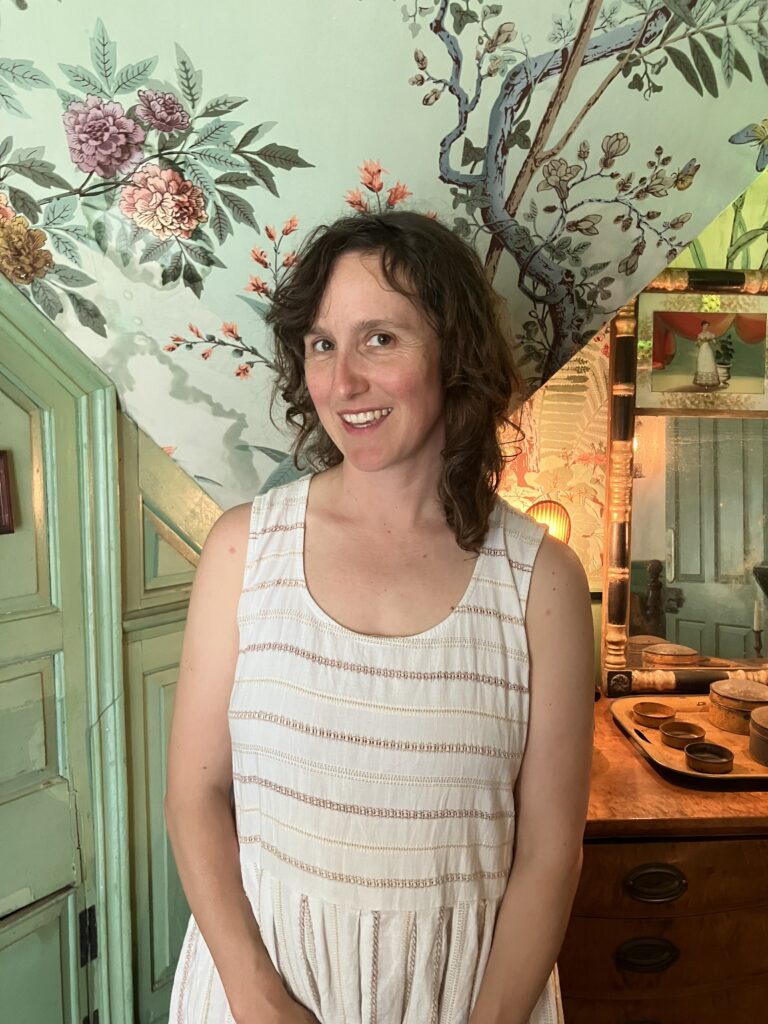 Gillian Osborne is the author of a book of essays, Green Green Green (Nightboat, 2021), a chapbook of poems and drawings, basic research (oxeye, 2023), and the co-editor of a collection of scholarship on ecopoetics. Raised as a Quaker in a small village in upstate New York, and trained as a poet and scholar of 19th-c. American and environmental literature at UC-Berkeley, she’s been the recipient of fellowships from the Harvard University Center for the Environment, the American Antiquarian Society, and the Emily Dickinson International Society, and has worked as a curriculum designer and occasional professor.
Currently, she lives in The Bay Area, where she practices writing, educating, and magic, and where she is reading Jennifer Chang’s An Authentic Life, Jean Rhys’s The Wide Sargasso Sea for a community discussion hosted by Womb House Books, Shekinah Mountainwater’s Ariadne’s Thread, and Ellisa Washuta’s White Magic. Recently, she finished rereading To the Lighthouse, which in case you didn’t know or had forgotten, is so good it is unreal.