
A Person of People: Noah Warren Reviews Kyle Carrero Lopez’s Party Line
Kyle Carrero Lopez’s Party Line (Graywolf, 2026) is a codex of reinventions. Writing in a wide range of modes—including shaped verse, an autotheoretical prose essay, a high lyric ode, and call and response—Carrero Lopez offers a model of collection-as-party, which different audiences are invited to inhabit in different ways. The formal variety of the volume mirrors the codeswitching verve of his gaily convivial speakers—who, under the pressures of race, exile (Carrero Lopez identifies as Afro-Cuban) and economic precarity, perform different identities to the family, the donor class, Fire Island, and the heterodox seethe of the club. In a witty early poem, this protean verve is symbolized by the crop top, which becomes infinitely restylable, rereadable, a “dress code break,” “cracked window” and “short story” (14). Such energetic proliferation of selves and idioms, the overt invitations to the party (with caveats: don’t be a dick), and its meditation on how to make community that depends not on universality but on difference, set up Party Line as an inheritor of the boisterously hemispheric side of the Whitmanian project. Its rich chorus includes also Guillen, Baldwin, and Clifton.
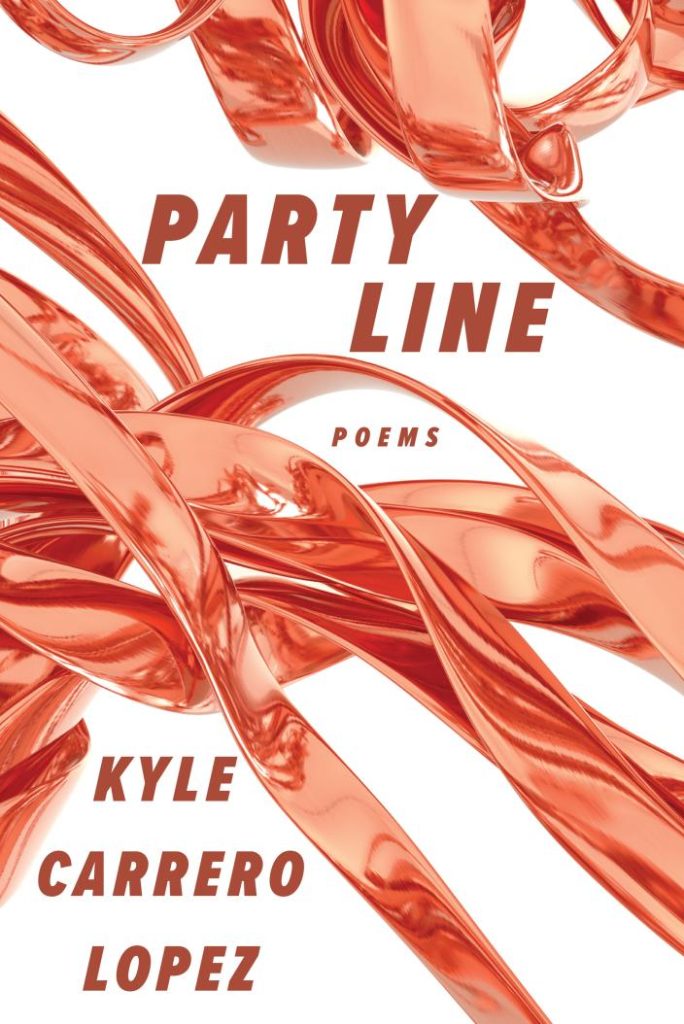
One of the central contributions of the book is its argument that poetry cannot be read or written without a precise accounting of its historical, economic, and socio-political contexts. Carrero Lopez enjoins us to ask, when reading an American poem, who paid for the time it took the poet to write, which White blindnesses warped the lit mag’s taste, and how much suffering was incurred at the hegemonic periphery to grow the capital that makes all this possible. The simpler implication of this dictum—that poetry and the arts more broadly call the reading subject not to transcendence of their communities and moment, but to a fuller engagement with and recognition of them—remains valuable even as it has become axiomatic, and is treated as such in this volume. Party Line, however, goes much farther. As the book progresses, we witness how this weaving together of poem, politics, and history revises 1) how we relate to others and ourselves in daily life; then, 2) what we demand of poetry; and finally 3) the scope of our political imagination. The answer that Carrero Lopez lands near is a kind of re-importation of the spiritual lessons of the Cuban revolution to the US, which requires, it turns out, the kinds of kinship, passivity, and imagination that poetry makes possible. If Carrero Lopez starts with an ironic, iconic “I sing the body electorate” (5), we find him late “lolling” on a “thrifted green velvet couch,” waiting for someone named “Chance” (72).
An early poem like “Sanctions” demonstrates how a recognition of historical and economic trauma necessarily conditions how the speaker acts in daily life and what they desire of aesthetics. The word “sanctions” is the only trace of geopolitics in this poem—set, as often, at a swirlingly erotic party—but as the title, it inflects each moment. Madeleine-like, the party’s dance track is one the father “used to play in his DJ studio, our basement”; the speaker reflects, with a note of Robert Hayden, “Music was the one love / he could hold without hurting” (13). We learn the sanctions in this poem refer to that father’s failed efforts to interdict nascent gender expression: “my first sanctions: no dance class / no ‘girl toys’ don’t walk like that stand like that.” The effect of memory is to redouble the intensity of the present: “to pile on tempo” as the speaker dances “on another man.” The question that Carrero Lopez pulls out of this scene, the question of “freedom at this level”—which I take to mean the question of to what degree the speaker understands themself as acting of their own volition in this knot of histories—is punted in the last line to “waking hours, where daytime makes us pay for this.”
Whether or not the speaker has freedom, the interval of the party, and thus the poem, is not “free”—it must be paid for. This charged, last verb brings full circle the economic framing of the title. What the poem traces, then, quietly, is the underside or the unconscious of an act of geopolitical cruelty, which masks itself in the emotionless language of trade and dollars. The father’s only act of expression, his DJing, takes place in the house’s basement, and its intensity and flexibility (DJing recombines; it cannot be strict) inverts the rigidity of his character. His attempt to “sanction” the speaker’s homosexuality, which reproduces the US’s bullying sanction of Cuba’s (political, social) self-expression, is the measure of the degree to which he himself is wounded and formed by that grander sanction. It is by tracing this haunt one generation further, into himself, that the speaker is able to measure how much is owed to history both public and familial, what the residuum of freedom might look like (viz., the poet/dancer’s semi-intellectual, semi-somatic attunement to tempo and beat), and how much of the debt will be paid, perhaps, in daylight.
(This generational debt, which begins in the US tally of the cost of Cuban nationalization¹ and can never be paid off, adds a transcendental aspect to the striking prevalence of debt and economic precarity in the book. For Carrero Lopez’s speakers are broke, almost always, and tell us as much: sometimes to explain their actions or unease, and sometimes, Adorno-esque, to pierce the American taboo of talking about money and show how social relations are conditioned by its obfuscation.)
Whereas “Sanctions” still offers a meditative, lyric speaker who assimilates world, self, and others, poems such as “Bloqueo” and “Embargo” are more entirely scarred by the event they compulsively name. Once we accept Carrero Lopez’s argument that poems are a way of doing history and (pace Pound) redistributive economics, these poems show us how deep formal consequences multiply, asking what happens when a poem works history or debt (and not, e.g., language) as a primary medium. In “Bloqueo (Social),” for instance, the impossibility of exchange results in white gaps on the page, in characters that have difficulty communicating, in laggy, distinct timescales (“Quick years turn factory to mother”), and in the poem’s refusal to corral these discrete sections into a single braid of argument. What holds it together is the bleak alienation in which the poem’s flashes of vision (“a blurred face in the amber, / eyes talking in sleep”) are hived—a material and psychic deprivation with a clear cause, in which “all things break, / chase” (55).
The utopian verso of this scarred poetics comes in a poem like “Compartir (Share),” a sonnet after a 2009 oil painting of the same title by Afro-Cuban painter Manuel Mendive. This sonnet also navigates a constraint: it progresses by rearranging the words of its first line, “Here, there has always been enough for us.” It is, paradoxically, a poem about plenty built out of the poverty of only eight words; but in its ingenious rearrangement of syntax, punctuation, and space, the effect is one of profusion. By its last line, the plainspoken, confident, “There has always been enough for us here,” the poem has earned, through sheer work, its dwelling and balanced rest (“There….here”).
The poem works—and this is the crucial point—not just because of its formal ingenuity, but because the ethos of invitation and participation, which Carrero Lopez proposes early, has by this late point in the book come to organize its effects entirely. The poem has no I, only simple deictics, an “us,” and time. It is “enough.” From this we might further understand that the mere form of revolution is sterile; it needs to be inhabited by what Che Guevara, the theorist of the Cuban Revolution, called the “hombre nuevo”— a subject in whom the “social conscience” prevails over the instinct for gain. We see this inward sociality in the book’s many poems after Cuban artists, in the tender sociality and care Carrero Lopez’s speakers find in the matrilineal line, and in the perforation and re-imagination of subjectivity in queer spaces. If we learn, early, that “Cuba changed life for Baraka—his young, careerist self / squelched, reforged by time abroad” (“Ars Poetica,” 19), it takes the whole volume for such a “reforging” of subjectivity to take place in the speaker.
It seems to me that much of this growth happens in the tenderness of the third section, which explores the maternal legacy. The first and second sections are brilliantly faceted, intellectually rigorous in their performance of political and historical critique; their worlds are pressurized, public, gay. Perhaps because the book has done its heavy lifting by this point, its third section allows itself to relax and become more vulnerable. If “Ars Poetica” states baldly the terms of Baraka’s conversion, its corollary in the third section, “The Socialite,” a tender portrait of the speaker’s Cuban grandmother, offers a slower, sharper reinscription of the same values—the reality of others, the care they ask of us:
My grandmother sleeps phone in hand, I bet.
Eve and a.m. her lines ring-ring, landline to cell and back again.
I bet she talks to everyone she’s ever
loved while she sleeps.
Communication, for the grandmother, outlives its content; we learn later of her encroaching dementia. “The Socialite” ends with a turn of the millstone, a conversion of lived experience to vow: “Let me always be a person of people / a socialite like her, before a product.” To arrive at genuine personhood, here, requires an ironic inversion of one ideal (“socialite” is rescued from connotations of the false and the high) and the defensive negation of that last, best commodity, the American.
It is when the poems sit with and listen to these women that Carrero Lopez’s wake work is most fully fleshed, most unassuming. This habit of sympathy and observation is reflected—as above, when the “I” disappeared—in a poetic line that does not just state its intention to join the dance but embodies it. Listen to the high music of this absorption in “Pati LaBelle and Celia Cruz (Alma Awards, 1998)”, as the child speaker watches with his mother
neither Spanish nor English,
cadence of congas,
swirl of white pearls
and emerald sequins: a Black
beginning.
A su cara, achoo
carve, azucar, azure scar—
alike Atlantic cicatrice
within both skins. (56)
This too is history, though of a different order: against the prevalent blockage and interdiction of US-Cuba relations, we’re offered here a moment of dazzling cultural creolization. In lines so finely tuned, the boundary between seeing and hearing becomes porous—as does the speaker, who seems to have laced himself into pure sound, pure flash of sequin and cicatrice. These interfusions are redolent with the recognition of sexuality to come but not yet arrived. Because the language for this nascent eros and self-identification remains undiscovered, the poem invents its own, and scats—breaking the rules of language—to make a deeper sense. What that break reveals is both the great horror, the Atlantic slave trade, and the way that that horror might be repurposed as a ground of connection and harmony—here, between the Cuban Cruz and the American LaBelle, both Black.
This is, finally, how I read the book: as an excavation of the grounds of community. Party Line asks, at various points, what rules we need, if any, to keep us safe around each other, to what degree our desires need to be attuned with others’, and how we might extract a fairer world from the ruins of American capitalism. One way of doing this, for Carrero Lopez, is by lingering in Cuba, and salvaging the spirit and ethos of its Revolution. The last of the great tutelary crowd of artists and revolutionaries at the Party Line party is Assata Shakur, who appears to the poet in a dream. It is utterly normal: they are at a farmer’s market in Havana. They talk about New Jersey.
*
¹ Law 851 was passed in Havana on July 6, 1960; it represented the first wave of nationalization. There are 5,913 U.S. claims against the Cuban government outstanding. The total value stood at $1.8 billion in 1960, and is now reckoned (through deferred interest and inflation) at about $18 billion. This is, of course, a completely fanciful figure.
 Noah Warren is the author of The Complete Stories (Copper Canyon, 2021) and The Destroyer in the Glass (Yale, 2016). His poems appear in The Nation, The Atlantic, The Paris Review, POETRY, and other venues. He is an Assistant Professor at the University of Vermont.