Dialectics for Nakba 2.0: Noah Warren reviews Edward Salem's Monk Fruit
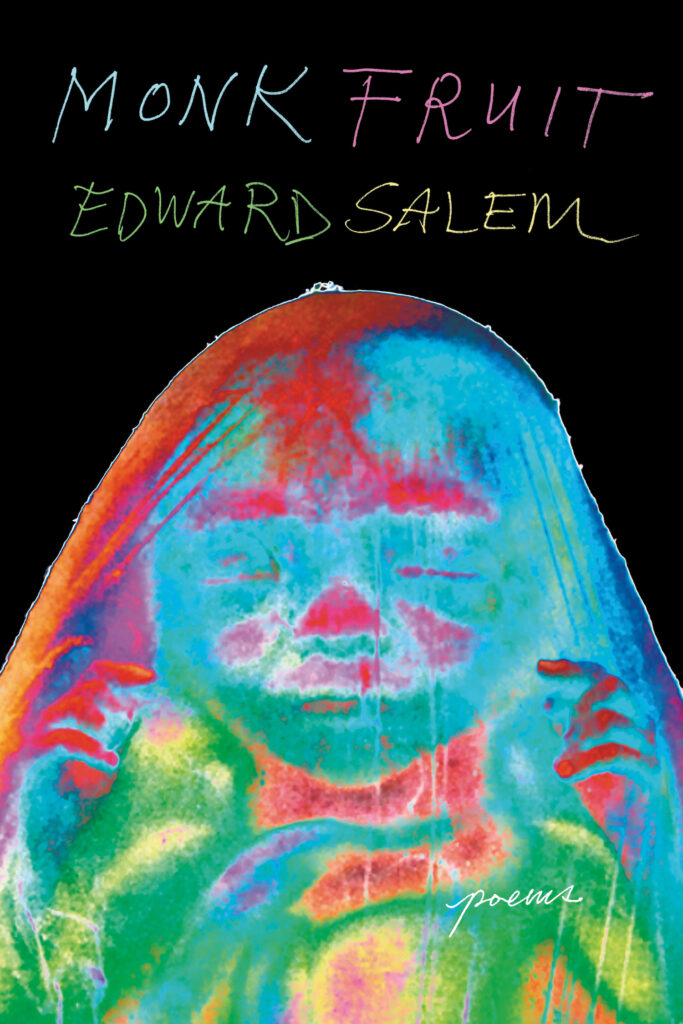
Gaza has changed the relationship of culture to politics. One casualty is language; the ongoing genocide committed by the Israeli state with American materiel and funds has revealed yet again the perfect venality of Western discourses of human rights and the capture of political parties by donors and interest lobbies. With the abdication of mainstream media organizations, this genocide is canalized through social media and arrives primarily through the phone screen, an interface fully policed by algorithmic nudge and soft censorship. So genocide becomes content. In the United States, the cynicism engendered by this fatal cognitive dissonance undermines the plausibility of an only-do-no-harm liberal order. And if that zombie Obama-era liberalism is finally dead, one task of this generation of writers and art makers is to figure out what to do with, or to, the specific forms of culture—often inflected by identity politics, and oriented toward the epiphanic—it subtended.
Edward Salem’s Monk Fruit executes, needles, and ironizes that culture. Anti-nostalgic and for the most part anti-sentimental, Salem, a Palestinian-American writer, operates by a sometimes furious, sometimes Zen, internet-inflected ricochet. Take “Dabls,” which confronts the sea of competing GoFundMes and the ways they require distracted subjects to evaluate incommensurate crises against each other:
The African Bead Museum is falling apart.
A GoFundMe has been started.
There are already so many GoFundMes
going around. Lately life is like
six degrees of Kevin Bacon but instead
of Kevin Bacon it’s Gazans fleeing 9en0cide.
But Detroit has needs, too, I’m reminded,
or do I mean poor Black Americans who
once placed their Hope in Obama.
We’re learning how to ride the internet
like an unbroken horse. We’re giving money
to each other. $100, $25 . . .
This interest in gappy mediation, and the use of zingy, corrupted language of contemporary mental life, sets Salem’s work apart from recent collections such as Mosab Abu Toha’s Forest of Noise and Fady Joudah’s […], which tend to use poetry as a technology to make the experience of suffering immanent, and to separate the signal from the “noise.” Salem insists prima facie that there’s nothing special about poetry. His debut volume spends as much time with the “Palestinian Chicken” episode of Curb Your Enthusiasm as with Donne, Camoes, or Aaron Bushnell, and relishes moments of seediness—nipple pliers, jacking off —so that any special piety for verse as such is pretty hard to maintain. At the same time, it’s not all hi/lo leveling; depth is derived from contrasting this cultural and ethical overfullness with Buddhist negation and the kalpas and fasting that produce it. It is possible to read the mostly-earnest monkishness of this often-ironic book as both a way of redeeming death (whether of a mother or of strangers on the internet), and a way of revaluing the helplessness, the emptiness, that watching genocide produces in the semi-engaged, semi-interpolated viewer.
The first poem, “Elsewhere,” showing us that viewer, sets up the contract with the reader:
I laughed at the phrase you used,
Emptied yourself. I thought,
It’s true, there’s nothing left.
I didn’t remember how many
drinks I’d had as I poured another.
Who cares, I whispered to myself . . .
The emptiness of language is taken for granted; what we have to read for is the attitude toward that language, toward others, and toward the world. If we startle, it’s not at linguistic intensity for its own sake, but at the reversal of expectations; for instance, at our being so promptly and personally meathooked into a previous conversation in which we are responsible for a “phrase” that we, like the speaker, can’t remember producing. It’s a Beckettian situation. Emptiness, here, is at once the emptiness of the personal pronoun — the pronoun’s indifference to identity — and the exhausted feeling of being somehow at the end of language itself, at least in the potentially erotic, potentially spiritual crux here quoted. As the speaker thinks to himself, “It’s true, there’s nothing left,” the perfectly unremarkable language alerts us to the waste of clichés that this book will have to wade through and hints at the repertoire of attitudes that will guide that journey. The poet’s first gesture is a bitter laugh, potentially mocking us, that refuses to explain; next, we see him promptly seeking to numb vulnerability. When the poem ends with an image of a drone like a “bumblebee” “vaporizing” “four men walking toward the border,” we are given an all-too discrete referent for “It’s true, there’s nothing left,” and thus understand the root of the speaker’s wound. In this mood, and in the metaphysics that draught after it, to orient oneself toward the “true” means recognizing that “nothing” is left: of the men; of Gaza; of belief; of language’s pleasure.
Desolate, certainly. But this is a book of unresolved, brittle juxtapositions, which, although they sometimes feel static, I prefer to understand as a dialectics without any hope of resolution, a “push pull man woman atheist theist English / Arabic American Palestinian slut virgin first cousin thing” (“Tchotchke”). Gamely, the volume’s second poem, “Monasticism” balances the “Elsewhere” of drone strikes with a here of “power lines / drooping above Detroit backyards,” and picks up emptiness not as a state of language or desolation, but as the preparatory state embodied in meditation. When the would-be-enlightened speaker of “Monasticism” opens his eyes to see “a fruit fly / the color of the brown glass / of the beer bottle it’s perched on,” it’s hard not to see the fly, like Yeats’s, as a symbol of the poet’s reflective and reflecting mind. For Salem, though, the image lies next to farce, and carries an edge of materialist protest; what living thing, after all, is quite dissociable from its environments? Capitalism makes everyone a tiny capitalist, as in ruins we become ruins.
This is a book haunted by absence, thus never at home, and so no single poem really provides a resting place for the reader or offers a stable poetic self or perspective that might guide us through. Rather, it is in the uneasy, renegotiated borders between poems that the reader is asked to dwell—in the translation from Gaza to Detroit, from violence to Zen, from disgusted irony to earnestness, and in the strange transformation of the militarized drone bee to the fly of consciousness.
This ricochet takes many forms. In one poem, the poet relates different narratives to his “two therapists, / who don’t know about each other.” In another, identity changes under the pressures, derived from liberal identity politics, on artists of color: “I flirted with white lying that I was Muslim / for a chance at Riz Ahmed’s $25,000 fellowship” (“Whirling Dervish”). The cynicism of such a voice, and its withering structural critique of arts economies under empire, results again in verse wielded like a truck. We see the soul-draining effects of such a system most vividly in the violence such a poem does to itself—the way it forecloses the possibility that any subject, might be inwardly free under a despotic state. Even the child self in “Whirling Dervish,” when he rebelliously sneaks the father’s rum and collapses on a suburban sidewalk, finds “the black of [his] / closed eyes blasted with g-force.” A moment of freedom darkens into violence wrought not on the system or on the father, but on the only available target, the self; and that violence is coded, in the last instant, with “g-force,” the maximalist, faintly technical language that seeps from a military industrial state and its entertainment industry. The killer drones live already inside our heads, “rent-free,” as the traumatized saying goes.
At its cynical apogee, this materialist model of subjectivity—which in effect reduces the speaking subject to a function of its contexts and an archive of the memes of yesteryear—results in a poem that reads like fractal chatter from the echosphere. “Give What You Can” is an historical catalogue, an ironic protest chant, a gibe at liberal culture, and a poem, as long as the category of poem includes also what might be called anti-poems. Halfway through its list, we get
Losing your degree. From the river to the sea.
Helicopter lost in the mountains. No excuse
(to look away, deny or defend the 9en0cide).
The second Nakba. The ongoing Nakba. Nakba 2.0.
If I must die. GoFundMe. The Pier.
Uncommitted. Art build. Hind Rajab. Tunnels.
Signal threads. Bird dogging. Kibbutz Blinken.
Refaat Alareer’s Kite. Targeting journalists. Strawberries.
The protest chant, with its hard rhymes and parallel structures, shows through intermittently; so does the sense of an open text being updated as we read, as the control-f surveillance state peeks even into poetry collections. It doesn’t matter who you are when you chant; what matters is that you add your volume, that you repeat the language. This is thus the final form of a materialist, coalitional subject delimited strictly by what it receives, by what happens to it rather than its freedom. And yet, in the poem’s flatness, in the uselessness of its already dated slogans, we see at the same time the stark limits of coalitional politics in a culture so captured by capitalism.
The bleakness of such verse poses a real question, mostly in the negative, about the kinds of language energy and work one turns to poetry for. For Salem, when he writes as a diagnostician, poetry becomes just another blip in the snowy radar of event. In a piece that so studiously maintains an unbroken surface, tragedy may inhere in the way that Refaat Alareer’s martyrdom, assisted by his poem, converts instantly into a kind of moral currency, which then accrues value through internet circulation. It may be that numbly retweeting has become one of the few ways the spectator’s grief (and thus belief) is made palpable to herself, its internal complexity reduced into the dominant phrasing and focus of the moment.
So one thing that “Give What You Can” and Monk Fruit at large offer is a discrete record of the ways the Gazan genocide has changed American language. But Salem’s starkest claim is not about the language it has given us so much as tone and the shape of the political/poetic subject. Writing verse so studded by worn phrases—verse which often, in its plain observation, approaches ecriture plate—Salem requires his readers to rethink how and why they come to (Palestinian-American) poetry in the first place, and what quiet cultural-political structures have a vested interest in Palestinian-American verse being either epiphanic or redemptive.
It’s the refusal of those poetic strategies, and thus the often-darkly-funny fuck-you to American liberalism, that make Monk Fruit such a distinctive and valuable collection. Its “I,” transforming poem to poem, refuses to be captured by the currency of identity politics, even as its various “yous”—sometimes intimate, sometimes harsh with irony—ensure the reader is always implicit and complicit in these acts of meaning-making, critique, and play. One leaves the collection excoriated, but as a result renewed and reattuned to suffering’s many registers. We startle back into the worst timeline, this one, where our work lies.
 Noah Warren is the author of The Complete Stories (Copper Canyon, 2021) and The Destroyer in the Glass (Yale, 2016). His poems appear in The Nation, The Atlantic, The Paris Review, POETRY, and other venues. He is an Assistant Professor at the University of Vermont.