Kenneth Reveiz Interviews Michael Leong
Dear Poetry Community,
Across several books of poetry, criticism, and translation, Michael Leong has created a body of work as restless as it is researched, and as inspired as it is collaged. Leong pluralizes what a book and a poem and a concept can be.
When I saw Black Square Editions (more on them later) share that Leong’s new book was coming out, I jumped at the chance to ask him about it. Dear Vase Already Shattered Against the Fragile Floor (2025) offers chunky, extended excerpts—for the first time, I believe—of his remarkable long-poem-in-progress “Disorientations.”
We spoke about poetry, community, and the practice of collage.
—Kenneth Reveiz
Dear Vase Already Shattered Against the Fragile Floor (2025) is the third volume in a projected pentalogy; the first two volumes Cutting Time with a Knife (2012) and Words on Edge (2018) were also published by Black Square Editions. I’m curious if you could say a little about your partnership with Black Square, and what they mean to you.
I really love this question because single-author publication is so often imagined as nothing more than a mark of individual achievement; while it is certainly that (in an overly obvious and limited way), such a viewpoint risks falling into the trap of neoliberal individualism and de-emphasizes the social and communal aspects that are the true pleasures of literary production. One of my favorite quotes about publication comes from André Breton: “One publishes to find comrades!” For the past twenty years, Black Square has been a vital source of literary camaraderie for me.
I like BSE’s mission statement so I’ll quote it here; according to its website, “Black Square Editions is a small nonprofit press, started by John Yau in 1999 with the intention of publishing translations of little-known books by well-known poets and fiction writers, as well as the work of emerging and less-established authors. John started the press for the same reason most small presses start: he wanted to see other types of authors being published.” In a basic sense, BSE offers an alternative to the mainstream.

I got to know BSE through John Yau, whom I met—quite fortuitously—in 2009. Back then, I was a doctoral student in Literatures in English at Rutgers, and I was teaching a class on contemporary American poetry. I remember having assigned some of John’s work in a unit on the prose poem. While doing some casual internet sleuthing in preparation for a class, I was shocked to discover that John was teaching at Rutgers at the Mason Gross School of the Arts. Since institutions are so siloed, I had no idea he was there. I wrote to him expressing interest in his work, and we met at the coffee shop Irving Farm in Gramercy. I know this took place on May 18, 2009 because he had dated the signature on some of the books that I had brought for him to sign. One of them was Borrowed Love Poems (2002), which was an important book for me to read when I was an MFA student. At that moment, I was resisting this mold that had coalesced around me, this expectation that I was supposed to write a certain Asian American poem. Reading John’s work was revelatory for me since he breaks from that mold, and, at other moments, he takes up the mold and subverts it in clever ways. I mean—these are a few lines from “Autobiography in Red and Yellow” from Borrowed Love Poems: “In my youth I spoke / with forked tongue // and ate with forking sticks.” In my copy of the book, John wrote “great to / meet & talk / more to come.” My three BSE books are an outgrowth of that “more,” but there is also much more to that “more.” John was really generous in introducing me to poets and he introduced me to great work by sending me Black Square books. One of those books was Christopher Nealon’s The Joyous Age (2004). I just pulled it down from my shelf and opened it at random. This is from “Park Blocks”: “Tree you rhyme with strophe / You rhyme with I don’t think I have it in me but of course who does / You rhyme with an entire other register whose fragrance is the embarrassing obviousness of God.” That’s great verve! Over the years, I had come to the realization that some of my favorite American poets—Albert Mobilio and Andrew Joron, for instance—are Black Square writers. Right now, I’m working on an essay about the women writers of the Oulipo, which has an appreciative analysis of Marcella Durand’s translation of Michèle Métail’s extraordinary Earth’s Horizons: Panorama, which Black Square published in 2020. This is all to say that I read Black Square books really closely and with great enthusiasm; the press, for whatever reason, tends not to get the attention that it deserves, but it feels fitting to be part of the community or “coterie,” if one wants to call it that.
I would be remiss not to mention how beautiful the books are, and the interdisciplinary dialogue that happens when John, drawing on his doubled expertise as poet and art critic, picks cover images for my books. It’s a special privilege: John’s choice of paintings by Nicolas Krushenick and Gary Stephan constitute, in a way, visual commentaries on my poetry. I’d never be able to pick more apt images myself. The books are also very elegantly designed, and I was fortunate to have worked with Shari DeGraw, who designed Cutting Time with a Knife, and Shanna Compton, who designed Words on Edge and Dear Vase. My work has a lot of typographic/visual complexity and sometimes contains interpolated images and all of that was presented harmoniously on the page. Last but not least—Black Square’s managing editor Margaret Galey helped with a lot of the important details. She actually came through heroically at the last minute of the proofing process, catching an error that I had missed! It’s a small but mighty team. I know a lot of my fellow press mates but not all of them; I hope I can rectify that in the future.
Can you say a little bit about the cultural climate in which Dear Vase was composed, and how it might be different from the climate in which you published its forebears Cutting Time with a Knife and Words on Edge? The 2010s felt to me like a simultaneously very generative and yet very challenging period to be in poetry community in the U.S., namely “uncreative writing” and “conceptual writing” were “in,” which was exciting, but the sophisticated racism of official and unofficial verse cultures went largely unacknowledged. Race, power, and the identitarian are foregrounded in Dear Vase in a way that they aren’t in your two previous books, yet each is deeply engaged in the conceptual, as well as the surreal.
Cutting Time with a Knife came out in a tremendous spurt of graphomania across 2009 and 2010. I basically wrote all day for nine months in a row on a cheap HP mini-laptop. I was most likely not paying much notice of the cultural moment in that period since I was sort of like a mad monastic alchemist completely fixated on the task at hand; but before that I was probably following how different writers from, say, the Flarfists to Dionne Brand—Inventory was an important book for me while I was a doctoral student— were responding to the George W. Bush era and the catastrophes of the Second Gulf War and Katrina. Some of the oldest material in Words on Edge is from the same period; but, by the time I was putting that material together, I was having a greater sense of self-reflexivity in relation to “uncreative writing” and “conceptual writing” and wanted to do things differently. In addition, what Lev Manovich calls our “culture of remixability” was in full swing, and I was quite interested in the mashup as a demotic cultural practice—from Danger Mouse’s The Gray Album (2004) to really goofy stuff like Seth Grahame-Smith’s Pride and Prejudice and Zombies (2009). I published a somewhat pompous essay called “Notes Toward an Interventionalist Conceptualism,” which Modern Language Studies ran in 2012, and have a critique there of Kenneth Goldsmith, which is—and this is to your point—quite different from the critique I have of his “The Body of Michael Brown” (2015) in Contested Records (2020), my book on documental poetry.
I started writing Dear Vase in 2015; to be more precise, I started the ongoing long poem “Disorientations,” which is, in many ways, the centerpiece of the book in 2015. (Some of the other material is older.) I had the idea to remix Kent Johnson’s Doubled Flowering and Roland Barthes’s Empire of Signs a few years previous to that—around 2012, I’m guessing. So the casual racism of Goldsmith’s Michael Brown piece was certainly stinking up the air at this time, but I had still been trying to metabolize older racisms going back to Johnson and Barthes, both of whom I was reading as an MFA student in the early 2000s. I was also reading Yau concurrently. I suppose that I had gotten to a point to feel ready to tackle the ethics of engaging with traumatic memory. Perhaps Words on Edge prepared me for that since that book is more political than the highly esoteric Cutting Time with a Knife. I remember the moment I actually started writing “Disorientations” because I was new in town in Albany, NY and James Belflower and Matthew Klane had invited me to take part in their Yes! Poetry & Performance Series; I thought it would be a good opportunity to read some new work so I drew up the first few pages of the project specifically to present at that event. Interestingly enough, the collage on p. 47 was one of the first pieces that I made; I recall projecting that onto a screen for the reading. Shanna did a great job enhancing that image for the book version: it both looks elegant on the page and captures the interest I had at the time in what Hito Steyerl calls the “poor image.”
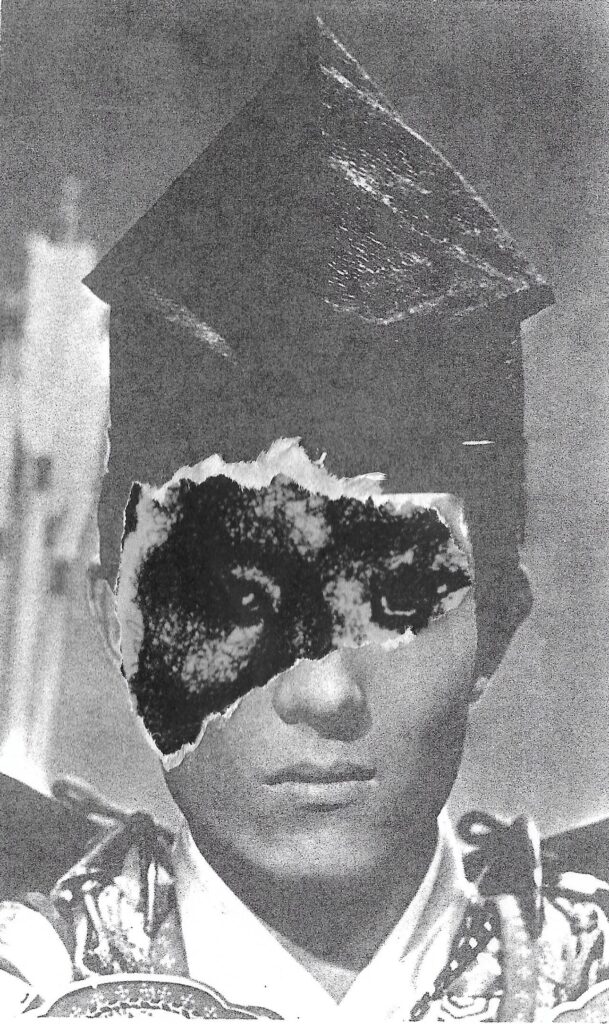
A test version of the collage on p. 47.
So Dear Vase came together over a period of around nine years. I wrote “Li Po Meets Oulipo” in 2014—that was first published in a 2015 chapbook by Belladonna—and most likely the most recent pieces from “Disorientations” came together as recently as 2023. It’s important to note in this context that 2014 is one year after Dorothy Wang’s book Thinking Its Presence: Form, Race, and Subjectivity in Contemporary Asian American Poetry, which helped me better articulate to myself what I was doing on the overlapping planes of linguistic form and subjectivity. I had reviewed that book for Contemporary Literature and had organized a virtual symposium around it a bit later for Syndicate so I read it quite deeply. 2014 was also the same year as the first iteration of Prageeta Sharma’s conference Thinking Its Presence: Race and Creative Writing. In terms of the latter, I came to the party late (mostly because of professional contingency)—I didn’t present anything at Thinking Its Presence until 2023—but I was, in a way, working in parallel with that group for the past decade or so.
Dear Vase makes clear that collaging, remixing, and creative editing are tremendously potent gestures for poetic composition – and these aren’t gestures that are usually discussed in conversations on writerly craft. I’m curious, as you edit/write/collage, what barometers you have in mind. How do you approach the extant language in the assembly of a poetic text? When are you satisfied? As an example, I loved the spaces before the punctuation marks like colons and commas in “Transmitting the Vertical Immensity of Coniferous Light” [cf. pages 19-26]. The indentations and sets of discrete phrases accrue and feel at once staccato and continuous, fragmentary yet cumulative, and accomplish a tone that is at times wonderfully prophetic. What does it look like for you to arrive at something like this poem?
Writerly craft is supposed to represent the “elevated” art of poetry while collage, the mashup, and the remix are tainted by the amateurism of “low culture.” Anyone can collage and that’s part of the scandal. Anyone can throw up a mashup on YouTube. Give someone a sharpie and they’re ready to do an erasure poem. But why should it be any other way? As Lautréamont insisted, poetry should be made by all not by one. For the craft-based mafia, “real poets” are supposed to take in their daily smoothies of Louise Glück mixed in with back issues of The New Yorker (preferably from the Alice Quinn days) and Norton anthologies for roughage. Mainstream creative writing culture also still believes in the clichéd quest of “finding your voice,” which supposedly enables the ones with the highest levels of craft to access universal appeal. Glück won the Nobel Prize “for her unmistakable poetic voice that with austere beauty makes individual existence universal.” It’s completely nonsensical. Collage, in contrast, is anti-voice. Collage can rupture the congealed status quo of how reality is represented, letting surreality seep through.
From my perspective, the ideology of craft is still mired in all the biases of white middle-browism and, well, the racism of official verse culture. I have this polemic against the very term “craft”—on the grounds of what you’re calling “race, power, and the identitarian”—in an essay that I wrote called “Post-Craft,” which is forthcoming in Caroline Gelmi and Lizzy LeRuds’ edited collection Teaching Poetry Now (SUNY Press, 2026). This is an excerpt from that piece to give you a taste:
Early twentieth-century advocates of institutionalized creative writing conceived of craft as a portable and teachable set of disciplinary skills, in part, because they were assuming a certain cultural homogeneity in their student body. According to Wilbur Schramm, the founding director of the Iowa Writers’ Workshop, creative writing students should “read other men’s work with the intelligent understanding of a fellow craftsman, in order to see how others have met the common problems of the craft and to estimate the effectiveness of their solution.” But, as Laura Riding sensibly observes, “workmanship is as various and contradictory as the number of workmen”; “common problems” can rigidify into problems for white (male) writers. As student populations become increasingly diverse, we need to keep the permeable boundary between poetry and not-poetry as open as possible so as to admit the widest possible range of cultural practices. We need to break down the received categories of poetry, fiction, creative nonfiction, and criticism that segregate interdisciplinary ways of knowing and making.
I really like your questions because they get at the heart of the strange but powerful relation between reading and writing, or to put it in more general terms, consuming and producing.
My process of remixing found texts usually begins with digitization via transcription: that is, I type out the texts on my computer so I can more easily manipulate the language onscreen. I like to see chunks from different source texts juxtaposed on the same page and I like the computerized maneuverability of cutting and pasting and clicking and dragging. As I re-read what I have transcribed, I usually key in on certain words that catch my interest and I snip those out of context. Then I cobble together those words and phrases from the source texts according to my acquired sense of musicality, figuration, and syntax. I’m satisfied when I think I’m creating a surprising amalgam of sound and sense that is just beyond the limits of my intelligence. In that way, I hope my writing is more perceptive than me.
I can pull out a small example phrase from “Disorientations” and attempt to reverse engineer my process:
But, in the interests of the long, undated renga unknown to us,
we must tally down the layered encounters,
the conscripted collaborators
from that invented fissure
between Orient and Occident.
This is from the beginning of the project since these terms come from the beginning of both Empire of Signs and Doubled Flowering. The words “renga,” “collaborators,” “conscripted,” and “undated” come from the latter since there is some faux editorial explanation about Yasusada’s “life”—that he had written collaborative renga with some of his contemporaries, that he had been conscripted into the Japanese army in the 1930s, and that some of his manuscripts are undated. “We must tally down” stitches together a portion from Empire of Signs. This is the beginning of Barthes’s sentence: “Someday we must write the history of our obscurity—manifest the density of our narcissism, tally down through the centuries the several appeals to difference…” The words “Orient and Occident” come from Barthes as well. All this takes a long time but that’s part of the point. The slow process of considering words that may not be a part of my usual lexicon and cobbling them together generate a certain amount of prolonged energetic attention, which unlocks a special orientation towards language. It’s not so different from someone taking the time to compose fourteen lines that follow a certain meter and rhyme scheme. In a way, what I do is in the liminal zone between collage and writing since I’m cutting into texts at a very fine level of granularity.
I’m glad you liked the spaces and punctuation of “Transmitting the Vertical Immensity of Coniferous Light,” which is a work of experimental ekphrasis. I was responding to an exhibition at the Met called “Diamond Mountains: Travel and Nostalgia in Korean Art” and all of the language comes from the exhibition catalog. The centerpiece of that exhibition was the work of the painter Jeong Seon, and I was greatly impressed by how he renders the density and texture of the rocky structures of Mount Geumgang. The design of “Transmitting” was an homage to his brushwork, which I found to be “staccato and continuous, fragmentary yet cumulative.” Thanks for that phrase!
Your long poem-in-progress “Disorientations” is obviously a major (and ongoing) event. I really admire your decision to begin this poetry collection with an excerpt from “Disorientations” – which is excerpted yet again later in the book, developed even further through the extended prose piece “Notes Towards a Disorientalist Poetics” at the center of the collection, and then, finally and subsequently, excerpted at length at the book’s close. All this stands out to me as a structurally ingenious and discursively invigorating method of assembling a poetry collection. Could you say more about how you went about building this book, and to what degree you had the long poem “Disorientations” in mind?
I’m so glad you’re mentioning how I sequenced this manuscript since that took a very long time to figure out. I more or less wrote Cutting Time with a Knife in order. That was my first extended experiment with textual collage, and since it was such a focused project, it came out ready to go: like Athena coming out of Zeus’s head with a full suit of armor. A lot of the writing of Words on Edge was done way before the book came out since ordering the material wasn’t straightforward. Back then, I had published all these different types of chapbooks and was really interested in the chapbook as a unit of composition, but it wasn’t straightforward to me how much of that work could be effectively recontextualized in a full-length collection. There was a lot of writing—enough material for two books—and much of it was pretty dense. Earlier versions of that manuscript were a lot more sprawling and the organizations tended more towards a “new and selected” volume. So it took a lot of cutting and re-organizing to make that book more reader-friendly.
Dear Vase posed similar challenges in terms of sequencing, which took a long time to resolve. At first, I thought I would simply complete “Disorientations” and publish it in two or three substantial volumes. Then I realized that “Disorientations” was intimately connected with so much other writing that I had been doing—for example, “Transmitting the Vertical Immensity of Coniferous Light” and “Li Po Meets Oulipo”—and that there was something to be gained in presenting that seemingly unconnected work under one cover. And there was something to be gained by taking my time with “Disorientations,” letting it advance organically with all the rest that I do. Deciding not to present “Disorientations” as an uninterrupted and continuous sequence—that is, to have a few excerpts flank other material in advance of the major chunk of the long poem—made the book click into place aesthetically. Letting go of presenting the long poem as a tightly coherent, centripetal entity and treating it as a more porous construction allowed me to better orchestrate what I thought would make for a rich and balanced reading experience.
I enjoy checking in on your blog, michaelleong.wordpress.com, where readers can find a link to Black Square Edition’s “Michael Leong Bundle” offer – and incidentally, I’ve also been seeing pictures of your co-translation of Vicente Huidobro’s Skyquake on my Instagram feed. You write creatively and critically, translate, teach, participate in community events, and curate reading series… do you have any advice for folks excited to participate in and build up a community around innovative writing?
While writing, researching, teaching, editing, translating, and curating are, of course, work-intensive ways of community building, participation can take many forms: showing up at a reading, buying a small press book, supporting your local bookstore, or subscribing to a little magazine if you can afford such activities. Asking if your local library can carry certain titles or magazines. Even talking about and recommending books to people around you. Spreading the word about the undersung. Those are all meaningful actions. Especially if done consistently over time. Obviously, write a lot of innovative work and publish to find comrades. Reviewing your contemporaries is a great way to create a direct dialogue with others. Then for those who have the mettle, starting something—a press, a publication, a reading series, a conference—and seeing how long it can thrive can make a meaningful impact.
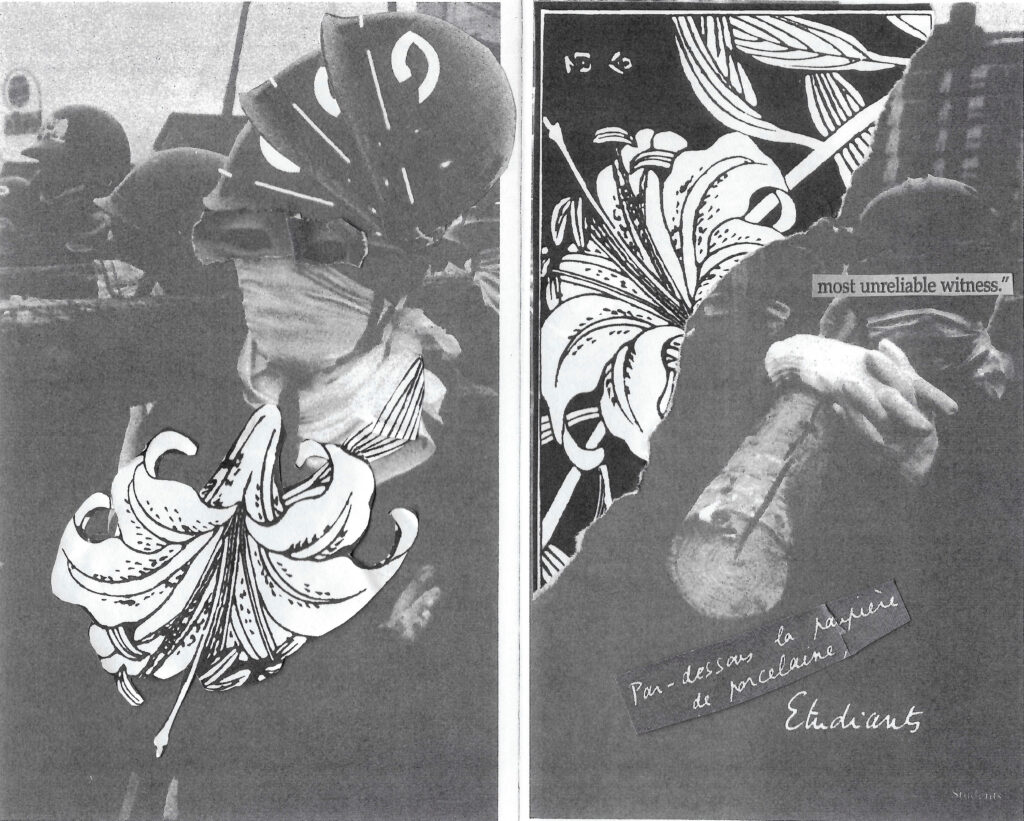
Collage from Leong’s process.
The ecosystem of innovative writing is pretty diverse and expansive, and there are always new avenues to explore. So there are always things to support. Not too long ago, Jared Daniel Fagen had written to me and asked if I had work for his journal Vestiges: A Print Journal of Literature, Art, and Poiesis, which is an arm of Black Sun Lit. I had sent him something for issue 7 and when I got my contributor’s copy last Spring I was greatly impressed with it. So many of my favorite writers were in there. I knew Black Sun Lit was interesting and have some good titles on my shelf, but I want to get to know the catalogue better. In fact, I just pre-ordered Will Alexander’s Aunonomic Reasoning from Black Sun Lit. I’m sure that’ll be good. And—to circle back to the first question—I just ordered Jared’s Black Square book The Animal of Existence. It looks amazing.
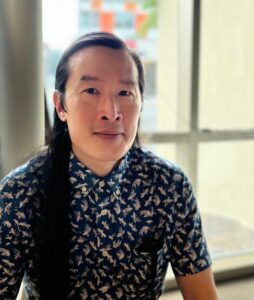
Michael Leong is a poet, critic, editor, and educator. His most recent books are Dear Vase Already Shattered Against the Fragile Floor (Black Square Editions, 2025) and Contested Records: The Turn to Documents in Contemporary North American Poetry (University of Iowa Press, 2020). He is Robert P. Hubbard Assistant Professor of Poetry at Kenyon College. He co-edits Journal of Modern Literature.
Kenneth Reveiz is the author of MOPES (Fence Modern Poets Series). Reveiz’s interview with Michael Leong is the first in a series of interviews which will run exclusively on The Constant Critic.