
Dear Jack: Spicer’s Magic Correspondence
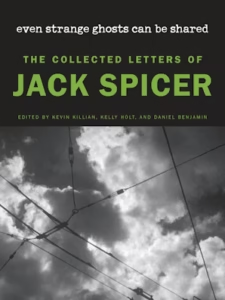
Even Strange Ghosts Can Be Shared: The Collected Letters of Jack Spicer
Jack Spicer (Ed. Kevin Killian, Kelly Holt, and Daniel Benjamin)
Wesleyan University Press, 2025
Reviewed by: Gillian Osborne
November 17, 2025
For personal as well as practical reasons, I have been wary of receiving transmissions from the dead. But one morning a few years ago, biking to daycare with a toddler on the back, it occurred to me that I might not mind vocalizing a ghost, if that speaker was Jack Spicer.
I had just begun seriously reading his poetry, beginning with his 1956 collection After Lorca, which weaves together letters to Lorca with slant translations of his poems and Spicer’s original writings. That had led me to the recordings of Spicer’s lectures, delivered in Vancouver, in June of 1965, just months before his death in a hospital in San Francisco. In these lectures, available as audio files on PennSound and in a volume edited by Peter Gizzi, Spicer articulates his mature poetics, including the concept of dictation: that a poet is “an empty vessel,” a “receiver” like a “radio” for “whatever’s Outside.”
This vision of the poet as recipient of “messages”—in direct opposition to more Romantic notions of the lyric, in which poetry was, say, the “overflow of” individual “emotions”—appealed to me greatly. I had spent a lot of time as a child and teenager sitting in Quaker meeting houses, waiting for a “spirit” to speak—and being pretty disappointed with the messages this spirit delivered to others, which mostly seemed to be about whatever that vessel had been thinking as they walked their dog before meeting. Spicer’s description of dictation also anticipated one of my favorite sequences of environmental poems, Lucille Clifton’s “message from the ones,” a series she received from a chorus of voices in the late 1970s, but didn’t print until her 2004 collection Mercy:
the air
you have polluted
you will breathe
the waters
you have poisoned
you will drink
when you come again
and you will come again.
The students I shared Clifton’s poems with had found these speakers spooky, alien; in his lectures, Spicer refers to the voices that deliver poems to the poet-radio as “spooks” or “Martians.”
I loved these otherworldly voices when they were transcribed by others. I inhaled all of Spicer’s poems, greedily. But the prospect of actually being an antennae for one, or ones, frightened me. What if that voice didn’t arrive impersonally, but as an individual I had known? A voice I could already summon, without even needing to empty myself to receive it?
I had never heard a voice in Quaker meeting. It was one of the reasons I stopped going. But once, a friend in New York, a witchy healer, had invited someone I had loved, who had died, into the room where we were sitting to deliver a parting message. At the time, this was profoundly comforting. So welcome, the thought that she could hear a voice I didn’t think I still could. That year, I wrote more poems than at any other time, all addressed to this one who was gone. My attention was drawn upward, into hawks and storms and wind. The world felt thin. But later, all that backfired. On some other visit to this same friend, sleeping alone in the room where she had received this missing voice, the one I had been writing to came to haunt me. He was in the room, I could feel him now. And it didn’t feel like he had come to listen to my poems. It felt like he had his own message to deliver. Or he was the message. And it didn’t have anything to do with words.
That experience scared me so much, I put away all the poems he had drawn out of me. In life, we had loved and argued. “We quarrel as we feed,” as Marianne Moore writes in her poem “Marriage,” which navigates a contentious togetherness that can result in “one’s self quite lost,” an “experience” that “attests / that men have power / and sometimes one is made to feel it.” What if he had come not to elicit poems but to take them. I found it safer to be quiet, just as I had as a child in meetings; to look out the wobbly glass of the windows, language-less, and feel connected to the trees. I put away poetry completely, for many years.
*
All of this makes me think there is a significant difference between messages from a voice without a face and those from someone you might actually know. And yet, Spicer also sent and received many personal messages, both as poems and as letters. The latter of these are at last gathered together in Even Strange Ghosts Can Be Shared: The Collected Letters of Jack Spicer. This edition completes a missing link in the corpus of Spicer’s published work: it is the fourth in a series of editorial efforts all published by Wesleyan—begun by Kevin Killian and Peter Gizzi, continued by Daniel Katz, and now by Kelly Holt and Daniel Benjamin—to bring the poems, lectures, plays, and Spicer’s correspondence into wider circulation.
“It’s so much easier to write something if you’re writing for someone,” Spicer writes to Graham “Mac” Mackintosh, a correspondent who elicited some of his most performative and playful letters. [1] All the letters to Mac are from 1954 and ‘55, when Spicer had recently returned to the Bay Area, after spending two years ostensibly in exile at the University of Minnesota for refusing to swear a McCarthy-era political loyalty oath then required of all employees by UC-Berkeley. Upon returning, Spicer taught at California School of Fine Arts, where Mac was one of his students. The letters begin after Mac is inducted as a private at Fort Ord, in Monterey. From the very beginning, Spicer is showing off. The second letter, for example, is an incredible tour-de-epistolary-force, written in the style of a newspaper, in which citizens, Martians, and celebrities combine to protest the “controversial imprisonment of Graham Macintosh,” Spicer acquires a baseball team, “John Spreadeagle” writes a queer mini-biography of Emily Dickinson, and Greta Garbo sends her love. I swooned and laughed so many times reading these letters, and I imagine Mac did, too. “I could spend years inventing landscapes for you to walk in,” Spicer writes. “Oz would be a very nice place for us to go after you get out of the army. It’s difficult to find, of course.” [2]
In the playful seduction of these letters, we see one side of Spicer. But there is also a combative, and even bigoted side, that appears, unguarded, in other letters. And there is yet another side that may have relied on the performance of intimacy in letters because the realities were too often disappointing. Maybe one of the reasons Frank O’Hara and Spicer were so notoriously at odds when they met in New York during the only other sizable chunk of time Spicer spent outside of California was that they were both practicing a kind of “personism,” but within radically different value systems. [3] If the “Personism” O’Hara defined in his 1959 manifesto is casual, haptic, characterized by ease, bumping into a friend on the street, or ringing them up on the phone, Spicer’s version is a charged arena wherein the visible and invisible meet. To Gary Bottone: “We can still love each other although we cannot see each other…we can continue to love each other, by letter, from alien worlds.” In this personism, the loved one is always also missing, even when the other state where he is living is in the very same room. To James Alexander: “The letters will continue after both of us are dead. The letters would continue even if we were in the same room together.” [4]
In this way, Spicer’s personism is ringed round with the occult. It makes sense, then, that the idea of “magic” was such a recurrent, talismanic term for him. We see the term emerge in his earliest meaningful friendships with Robin Blaser and Robert Duncan, when the three met each other as undergraduates at Berkeley in the mid-1940s. In one of his earliest letters to Blaser, Spicer describes Duncan’s “magic making,” and advises, “it is time for you to make magic.” While in an early letter to Duncan, he wards against the older poet’s magisterial creativity—“Answer this letter without magic. Pretend I’m your mother in Bakersfield,”—while also reminiscing about “the magic of the poems and stories” Spicer wrote “in the years I knew you best.” [5]
Magic also appears in Spicer’s letter to Graham Mackintosh. And I think that it is here, in these letters to Mac, where we see Spicer working out what his poetry could be through the lens of magic and its meanings, which would come to define his mature poetics in the years to come. In an early letter to Mac, Spicer first rolls out the idea of magic as blasphemous, a dark counterpoint to the Christian theology he had been raised with: “I’m going to ask some Catholic what saint one prays to to get a person out of the army quickly. Magic is all very well but one needs help from the other side too.” [6] Later, Spicer invokes a classic Aleister Crowlein sense of magic as will exerting influence over matter when, after describing the rain to Mac in one letter, he notes in the next: “If only the rest of my magic was as good as my rainmaking! It has rained everyday since I wrote that fatal letter.” [7] In another, he writes, “NONSENSE IS A FORM OF MAGIC.” And finally, he counsels Mac on the similarities between poetry and magic: “I discovered that fear of the supernatural could be used in poetry and magic (if these things are different) and could give me a kind of contact with things outside of myself.” [8]
The ideas folded into magic—of blasphemy, nonsense, the “outside”—all came to be central to Spicer’s practices. In 1957, after a brief second exile from California—having gone to New York to see if he could get famous and deciding he’d rather have friends—Spicer got set up by those friends to teach a “Poetry as Magic” workshop in the Bay, whose participants included Helen Adam, Robert Duncan, and Jack Gilbert. One of the prompts remembered by many of the participants was to write a blasphemy. [9] Robin Blaser explained the principle behind the prompt as “tear[ing] up and repropos[ing] the contents of what is other than ourselves.” [10] Spicer’s idea of “nonsense” was deeply tied to his idea of “Martians,” who were at once the transmitters of poetic messages and insiders of a poetic language and community. Complaining of New York to Allen Joyce: “No one speaks Martian.” And giving up on the east coast entirely: “MARTIANS ARE COMING HOME.” [11] Back in the Bay, Spicer hosted blabbermouth nights at a bar in North Beach; whoever delivered nonsense most long-windedly won. That idea of “things outside of myself” that Spicer had written of to Mac shows up in Spicer’s poems and lectures, and would become the focus of Robin Blaser’s long and beautiful essay, “The Practice of Outside,” written decades after Spicer’s death. [12] Magic was Spicer’s original term for all these ideas—of the experience of language “coming in” from somewhere else, of the “shock of recognition” of true poetic community.
Most of these ideas find their way into the letters via nuggets of writerly advice, which Spicer dispenses liberally. As he writes in another letter from this time, to Jo Ann Low, for example, “magic helps the most (but it has to be the kind of magic that is not ventriloquism—the voices can’t be your own).” [13] He was clearly a natural pedant, and an inspiring teacher; and in the satisfaction of receiving his good counsel, it’s easy to forget he had to learn it all first for himself. His method for finding one’s way to a unique poetics is, fittingly, distributed as advice. To Allen Joyce: “You’re going to learn it from your poems or you ain’t going to learn at all.” To Blaser: ”Any revision that is valid will come from other poems shoving inside you.” [14]
In the letter to Mac in which Spicer wonders parenthetically about the difference between poetry and magic, the surrounding context gives a sense of the journey to this realization:
Even up to my early adolescence, I used to be afraid to go to sleep because I would dream about ghosts—chasing me and singing in weird voices, things like that…Now, when a ghost comes into a dream I am still afraid, but I use that fear to force the ghost to tell me something. [15]
In writing to the living, Spicer uncovered the kind of poet, or magician, he wanted to be. And it turns out that a key component of that, for him, was to be the kind of poet who could correspond with the dead.
*
In his meticulous and thoughtful introduction to Strange Ghosts, Daniel Benjamin calls Spicer’s letters to Frederico Garcia Lorca a “magical act of conjuring.” [16] As other critics have noted, Spicer’s turn to literary letter writing—which begins with After Lorca, but continues into Admonitions (1957), and several collections for James Alexander (1958-59)—was likely influenced by Spicer’s reading of Emily Dickinson’s letters. [17] The first variorum of her poems, edited by Thomas Johnson, was published when Spicer was living in Boston. (“[P]oetry hates Boston,” he wrote in a poem from that time, which makes me laugh. That’s where I was born.) [18] Spicer reviewed this publication, arguing that “her correspondence” should be read “not as mere letters…but as experiments in a heightened prose combined with poetry.” Reading poems and letters together in this way, a “new approach…opens up.” [19] In the years that followed, Spicer made this approach his own, blurring the boundaries between letters and poems, a both/and togetherness that made some uncomfortable: “Ebbe was annoyed since he thought that letters should remain letters (unless they were essays) and poems poems (a black butterfly just flew past my leg) and that the universe of the personal and the impersonal should be kept in order.” [20] The blending of these is Spicer’s signature.
And yet: Spicer’s letters to Lorca are not included in The Collected Letters of Jack Spicer, even though Lorca is surely the strangest shared ghost of all among Spicer’s correspondents. Why not? The letters to Lorca exist in a similar category to Dickinson’s infamous “Master Letters,” her most acute example of what Spicer called her “heightened prose combined with poetry,” and whose addressee has never been definitively identified. Those letters do appear in Dickinson’s collected Letters. Perhaps the difference is that the Master, remaining unidentified, may have been among the living. Lorca, of course, was not. Apart from the fact that Lorca is dead, do the letters to him differ in kind from those to Graham Macintosh, or Robin Blaser, or James Alexander?
One thing Spicer’s letters share with Dickinson’s is a remarkable affinity for objects. Dickinson attached crickets and flowers along with letter-poems to enact this principle of correspondence: that words adhere to things. Critics have made much of the materiality of her language—its resistance to the transcendent, its rootedness in context. [21] Spicer’s letters to Lorca, perhaps more than any of his letters to the living, are reminiscent of this orientation. In the second of these, he writes, “Words are what sticks to the real. We use them to push the real, to drag the real into the poem.” [22] And in a third:
Things do not connect; they correspond. That is what makes it possible for a poet to translate real objects, to bring them across language as easily as he can bring them across time. That tree you saw in Spain is a tree I could never have seen in California…BUT…every place and every time has a real object to correspond with your real object–that lemon may become this lemon, or it may even become this piece of seaweed, or this particular color of gray in this ocean. One does not need to imagine the lemon; one needs to discover it. [23]
When writing to Lorca, Spicer fixates on correspondences between objects or their properties: lemons and seaweed, the color of the sea. This attention to material correspondences here has to do with magic—with what medieval physics called a “Doctrine of Signatures,” and alchemists summarized “as above, so below.” “This theory,” as Ralph Waldo Emerson described it in the 19th century, that “is this: nature iterates her means perpetually on successive planes,” producing “grand rhymes.” [24] It is also a kind of necromancy that transfers the powers of the dead into the flitting world they leave behind.
Perhaps the dead draw our attention to objects because, in contrast with themselves, any thing seems livelier. I have never stared so long at blackberry brambles, seed-pods, or wind, when thinking of someone I would never see again. And yet, notice that apart from his Introduction to After Lorca—an introduction channeled through Spicer, and in which Lorca notes, “The dead are notoriously hard to satisfy”—this lost poet to whom Spicer corresponds never returns a proper letter. [25] This is because the dead don’t write back. Or at least, not in letters we can read.
They do, however, leave us poems. And this was, ultimately, Spicer’s discovery: that correspondences exist not only between objects, and ideas, or among people, but create connections across time and space, through poems. “Even these letters,” he continues to Lorca, “correspond with something (I don’t know what) that you have written (perhaps as apparently as that lemon corresponds to this piece of seaweed) and, in turn, some future poet will write something which corresponds to them. That is how we dead men write to each other.” [26] Or as he writes in one of his most often quoted letters to Robin Blaser, in which he explains the draw of writing poems in series rather than as solitary notes: “Things fit together. We knew that—it is the principle of magic. Two inconsequential things can combine together to become a consequence. This is true of poems too.” [27] By writing letters to the living, Spicer found his way to another kind of correspondence. One that wouldn’t stop, even when he was gone.
*
More than any other genre, a letter is always outside itself. It’s outside its author, who is oriented toward her addressee. And it’s outside its recipient, in referencing its scribe. It is outside itself because it is addressed to someone who is not simply a presence invoked by language but a living being in the outside world, and because it needs to travel through time and space to be received by that breathing body. Like a metaphor, a letter is language that moves across, between, among. But there is no tenor and no vehicle in a letter. Instead, there are two people who like or are annoyed with one another enough to take the time to write.
In a letter to James Alexander, Spicer memorably describes Robert Duncan and his partner Jess’s house as “built mainly of Oz books…and miscellaneous objects of kindly magic” as “a postoffice. I had not realized how little alone one is in a postoffice,” he writes. [28] Maybe one is never alone in a post office because it is a space where the ritual of sending and receiving, being with and against, for and as, is concretized. Not only acted out, but licked and stamped. From within the echoey halls or the snug living rooms of the post office, one can hope for news from distant friends, and write to them while waiting.
 Gillian Kidd Osborne was raised as a Quaker in a small village in upstate New York, trained as a poet and scholar of 19th-c. American and environmental literature, and currently lives in San Francisco. She is the author of a weird book of essays and letters, Green Green Green, a chapbook of poems and drawings, the co-editor of a collection of scholarship on ecopoetics, and a curriculum designer for Poetry in America. Since the birth of a second child and turning 40 almost three years ago, she has been writing fiction, and studying magic.
1 Jack Spicer, To Graham Mackintosh #37, Even Strange Ghosts Can Be Shared: The Collected Letters. Ed. Kevin Killian, Kelly Holt, Daniel Benjamin (Wesleyan UP, 2025), 119.
2 Spicer, “To Graham Macintosh” #2, 3, 5, Letters, 72-77, 82.
3 Frank O’Hara, “Personism: A Manifesto” (1959), in The Norton Anthology of Modern and Contemporary Poetry. Vol. 2. Ed. Jahan Ramazani, Richard Ellmann, and Robert O’Clair (New York: Norton, 2003), 1072-1074.
4 Spicer, To Gary Bottone, To James Alexander #11, Letters, 62, 270.
5 Spicer, To Robin Blaser #3, To Robert Duncan #8, Letters, 48, 53.
6 Spicer, To Graham Mackintosh, #20, Letters, 98.
7 Crowley, Magick in Theory and Practice (London: Subscribers, 1929), xviii. Spicer, To Graham Mackintosh #14, Letters, 90.
8 Spicer, To Graham Mackintosh #40, 32, Letters, 122, 112-113.
9 Jack Spicer, My Vocabulary Did This to Me: The Collected Poetry of Jack Spicer, Ed. Peter Gizzi, Kevin Killian. (Wesleyan UP, 2008), 447.
10 Robin Blaser, The Collected Books of Jack Spicer (Santa Rosa: Black Sparrow Press, 1975), 35.
11 Spicer, To Allen Joyce #2; To Allen Joyce #17, 146, 149.
12 Spicer, “A Textbook of Poetry,” Poetry, 303; Spicer, The House That Jack Built: The Collected Lectures of Jack Spicer, ed. Peter Gizzi (Wesleyan UP, 1998), 5, 55; Blaser, “The Practice of Outside,” in Collected Books, 271-329.
13 Spicer, To JoAnn Low, Letters, 130.
14 Spicer, To Allen Joyce #15; Blaser #25, Letters, 182, 215.
15 Spicer, To Graham Mackintosh #32), 112-113.
16 Benjamin, “Introduction,” Letters, xv.
17 Benjamin, Letters, xv, 143. Daniel Benjamin cites Daniel Katz’s, The Poetry of Jack Spicer (U of Edinburgh P), 52-78, in reference to Spicer’s engagement with Dickinson’s correspondence.
18 Spicer, Poetry, 58.
19 Spicer, Lectures, 234.
20 Spicer, To James Alexander #4, Letters, 262-263.
21 Susan Howe, Virginia Jackson, Alexandra Socaridies, Jen Bervin, Marta Werner, Karen Armstrong, me.
22 Spicer, Poetry, 123.
23 Spicer, Poetry, 133-134.
24 Emerson, Essays and Lectures (New York: Library of America), 670.
25 Spicer, Poetry, 108.
26 Spicer, Poetry, 133-134.
27 Spicer, Letters, 232.
28Spicer, To James Alexander #7, Letters, 90, 211, 266.