
C.D. Wright and the Rural Avant-Garde:Revisiting Deepstep Come Shining
a review/essay on C.D. Wright's Deepstep Come Shining (Copper Canyon, 1998)
after the publication of The Essential C.D. Wright, Ed. Forrest Gander & Michael Wiegers (Copper Canyon, 2025)
by Ted Mathys
December 17, 2025
I grew up on an 80-acre farm in the rolling hills of northeast Ohio. My father was one of eleven children raised in a community of Apostolics, plain-clothed Anabaptist farmers. My paternal grandmother wore a head covering, quilted, and owned a cuckoo clock but never a television. My mother was a transplant from New Jersey, a high school French teacher doing her best to survive the isolation in the drafty farmhouse. She kept a big, irascible pet goat named Couscous. A neighbor harvested our crops because my father, like his brothers, worked in construction. He was a mason who ran a small company that did brick work and concrete block basements. When our family had the resources, he built us a house in a wooded area near the county seat, but we kept the farm and he ran his business out of the barn. Trowels and mortar mixers shared space in the barn with a combine harvester and an ancient dump truck. I worked construction for my father in the summers.
In college I read and wrote poetry but felt alienated from the coastal elite and their institutions of education, art, and literature. Nor was I particularly inclined toward the plainspoken, meditative farm poetries of writers like Wendell Berry or Ted Kooser, who wrote in the long shadow of Robert Frost. As for construction poets, some in the English canon were Freemasons, but not actual masons. I was aware of two carpenter poets: Whitman and Jesus. Garrison Keillor’s brand of enforced Midwestern hokeyness gave me hives. I was in search of new models.
When I stumbled upon C.D. Wright’s Deepstep Come Shining (1998), an enigmatic book-length poem that grew out of Wright’s travels in the rural South, the reading experience was as if the experimental filmmaker Stan Brakhage had made a film about my upbringing. The poem’s surface is scratchy, inflected with rural idiom. Narrative is eschewed in favor of perceptual intensities. A painterly effect builds up in clipped, syncopated sentences:
Deepstep. People just know what they are. (Come Shining).
The chicken’s name is Becky. They found her a good home with a peahen for fellowship. Chicken love.
Don’t park in the shade on my account.
If we let the windows down we can hear Cape Fear. Exhaust stink. Or is that Hog Waste Lagoon. Man alive, that’s foul.
Get your bearings. Hear the trees.
The silver threads of Spanish moss dripping from the telephone wires. It flies here. In pianolight. Like ghost hair.
Deepstep was singularly formative for me as a writer. The volume offered a third term that neither restricted rural life to the plain style nor walled it off from the artistic conversations of the urban intelligentsia. As a person from the rural Midwest with a desire to escape the provincialism of my past without abandoning my people or caricaturing that milieu, Deepstep’s model of what might be called the rural avant-garde was revelatory.
By rural avant-garde I mean the way Deepstep combines formal techniques often associated with urbane artistic and literary institutions – such as painterly abstraction, intentional perceptual defamiliarization, and challenges to the generic boundaries of verse – with content drawn from rural life.
Today, Wright’s reputation as one of the most innovative and unique American poets of the last half century is unassailable, and the critical consensus around her body of work has only deepened in the decade since her death. This year Copper Canyon Press released The Essential C.D. Wright, a career-spanning selection of Wright’s poetry from the mid-seventies through her final work, ShallCross, in 2016.
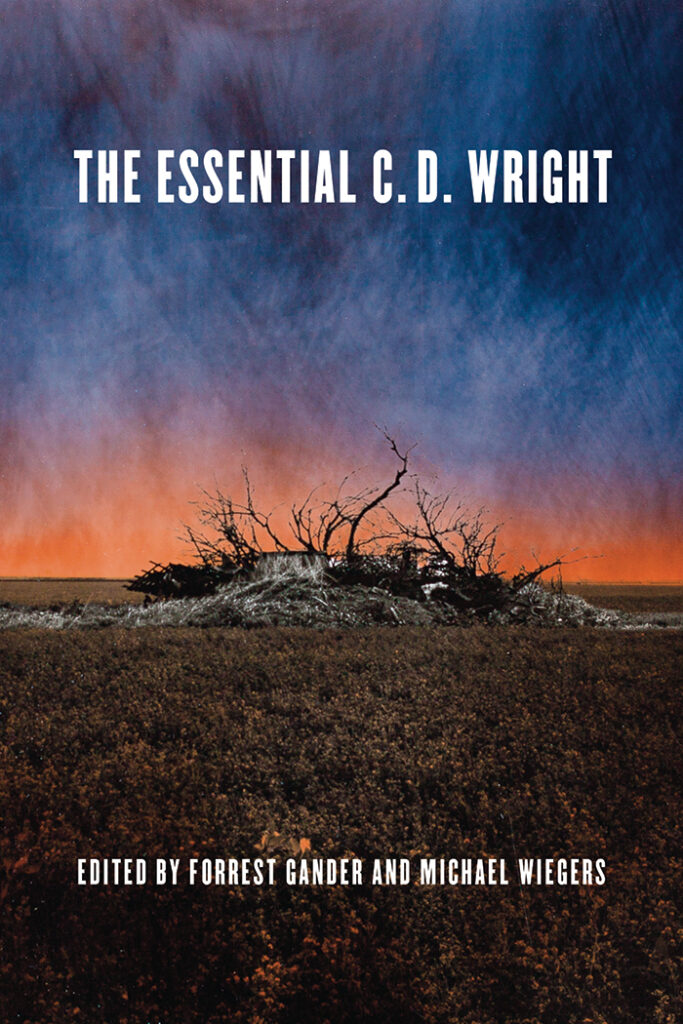
Given this new volume and Wright’s countless accolades, it is easy to forget that her work was not always universally celebrated. When I first read Wright’s poetry a quarter century ago, it had many detractors. To better understand her legacy, I think it is worthwhile to return to the critical conversation around Deepstep. The book confounded some critics and revealed in others a startling hostility toward the poetics of the rural avant-garde.
How and why Deepstep’s version of the rural avant-garde stirred up strong feelings should matter to us today. The book provoked debates about authorial identity and formal technique, about who has license to experiment with language and who carries the burden to speak for a demographic in a proscribed way. These issues persist. For example, in “Delusions of Whiteness in the Avant-Garde,” Cathy Park Hong parses how poets of color, despite having “vitalized the margins, challenged institutions, and introduced radical languages and forms,” have been largely excluded from the narrative of the 20th century avant-garde. Mainstream literary institutions expect writers of color to deliver “sanitized, easily understood personal lyrics on family and ancestry rather than make sweeping institutional critiques.” Conversely, “avant-gardists prefer… poems where race – through subject and form – is incidental, preferably invisible, or at the very least, buried.” This double-bind, Hong argues, leaves poets of color to choose between tokenization and erasure. Critical responses to Deepstep illustrate how a parallel dynamic, though not lodged explicitly on racial grounds, exists in the ways in which the rural sound is shaped and patrolled by literary elites.
*
In the mid-1990s, Wright’s friend and collaborator, the photographer Deborah Luster, proposed a road trip through the Carolinas and Georgia. The two would visit a roster of outsider artists as well as create work of their own “related to the dreams of the blind,” as Wright put it in a 2013 interview. Wright assembled a “frog fat” notebook of images, yarns, private allusions, overheard phrases, jocular spiritual advice from church marquees, ghostly memories, and aspects of vision and blindness, both physiological and metaphorical. From this notebook Wright crafted Deepstep Come Shining in the summer of 1996:
Stop at Bulldog’s will you for a six-pack of Icehouse.
The cornea does the work. The back wall is the retina.
Just a drop of silver nitrate in the newborn’s eyes. It’s the law. In case of syphilis. Thus are we treated as thieves in a department store and syphilitics in a hospital. Even the newborn gets the treatment.
We live by the etcetera principle.
All the cool people liked the children’s humping line dance. All the rest were horrified.
When in Rome…
By the rays of Light I understand its least parts, how my life does not appear in cursive, but in handwrit letters. Crudely executed.
SALVATION. DON’T LEAVE EARTH WITHOUT IT.
Reviews contemporaneous with Deepstep’s publication were mixed. The Yale Review and Publisher’s Weekly praised the work. But at a moment when poetry’s tussles turned on questions of accessibility, others balked at Wright’s formal maneuvers as well as who has authority to use them. F.D. Reeve, in Poetry, wrote that “Wright’s loose-jointed prose keeps coming round on itself, like dramatic dialogue, creating a faux narrative rhythm. What it signifies I don’t know…” He criticizes Wright for “the absence of political engagement,” comparing Deepstep negatively to Muriel Rukeyser’s U.S. 1 and suggesting that Wright had disappeared into a funhouse of literary reference. Kirkus Reviews issued a hostile indictment of Deepstep as “sometimes simply incoherent” and full of “Forrest Gump-like pearls of wisdom and lame bits of anarchic humor.” But the unassimilable problem for the anonymous reviewer was that Wright was a professor at Brown University who was eager to “establish her white-trash authenticity.”
There is a history of rural poetry being molded by the urban elite. The country house poem, for example, emerged from dynastic urban wealth. Developed in 17th century Britain, the genre traditionally featured a poet praising the architecture and grounds of their wealthy patron’s country estate. The broader pastoral tradition also developed as an antidote to city life. As early as the Idylls of Theocritus and Eclogues of Virgil, the shepherd tending his flock was an idealized vision of rustic labor, an escape into Arcadian innocence. The pastoral, Leo Marx writes in The Machine in the Garden, is a dualistic system that offers a “contrast between two worlds, one identified with rural peace and simplicity, the other with urban power and sophistication.” The later American pastoral ideal was intimately tied to the European concept of America itself, a form of false nostalgia for “an undefiled, green republic.” Marx describes the simple version of pastoral as a collective neurosis, a reactionary ideology that at once masks the industrial conditions which make life in modern society possible and requires movement away from the “artificial” and “art” of the sophisticated city towards its opposite – the simplicity of the country.
Read in this lineage, critical frustration with Deepstep is unsurprising, because the rural avant-garde threatens received categories. Rural avant-garde is a term infrequently used because, as Marty Cain notes in a study of rural poetry collectives, there is a mistaken, “unspoken consensus that urban centers alone have shaped avant-garde and modernist discourses.” The rural sound is surveilled by literati to ensure that rural poets offer “Goodness, hard work, and transformation of the spirit,” as F.D. Reeve, the Poetry reviewer, put it in his garland of clichés. Poets of the rural avant-garde are either failures of American goodness in their refusal of simplicity and accessibility, or they are class traitors who have gotten too big for their britches and need to be disciplined with terms like “white trash.”
It may be tempting to square this circle by invoking an essential rural or regional identity. Hick Poetics, for example, is the title of a 2015 anthology of contemporary rural American poetry edited by Shelly Taylor and Abraham Smith and published by Lost Roads, the small press at which Wright was previously a longtime editor. Taylor’s introduction addresses how the “stigma of rural – or worse, regional – has worn historical dress suggesting a lack of world-knowingness and style.” Despite excellent entries, Hick Poetics ultimately sidesteps the friction between rural content and formal technique at the heart of the rural avant-garde by framing the volume around an identity, “kids from the sticks” for whom “hick…is a powerful rib-jab reclamation of power.” Wright’s work is not included.
Still other critics slotted Wright’s poetry into the convenient regional category of the Southern gothic. Yet Deepstep’s speaker is aware of the dangers of “That self-conscious Southern poetry, preposterous as a wedding dress.”
For me, Deepstep is essential not for its geographic Southernness or for Wright’s Ozarks-inflected idiom that would align the poet with a stable, downhome identity position, but rather for the way Wright uses experimental formal techniques to animate rural life. In his 1999 review, Mark Nowak called this Wright’s “polysubjectivity.” “Denying her ties to neither the eccentricities of the rural South…nor academic/institutional life,” Nowak writes, “Wright melds these disparate voices.”
*
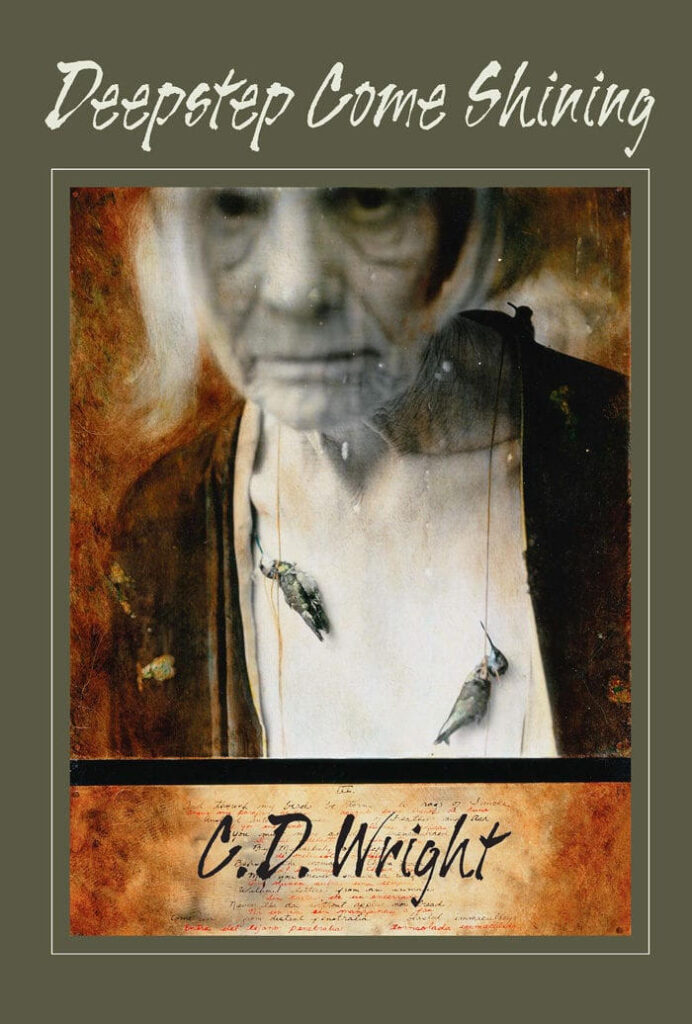
My first job after graduating from college in 2001 was tutoring English at a small university in Hong Kong. I packed one suitcase. I wanted a book for the flight. In the local bookstore, Deepstep’s haunting cover, title, and design arrested me. Who is this woman with wraithlike silver hair, holding the reader in a tractor-beam stare, dead hummingbirds strung around her neck? What is Deepstep? Why are there columns of inscrutable stenotype punctuating the collection?
I read Deepstep on the Cathay Pacific flight at night in a cone of antiseptic cabin light, over the Pacific. The poem opens in medias res: “Meanwhile the cars continued in a persistent flow down Closeburn Road.” The first word, “meanwhile,” drops the reader into a parallel world that is coeval with but slightly estranged from the American present. Historically rooted signifiers (Motel 6; Gold Bond Medicated Powder; Michael Jordan’s father napping in his Lexus just before he was murdered) are woven together with gothic touches from swamp doctors and folk healers like “boneman,” who advises to “apply flax and whites of eggs to bleeding eyes.” Some images are otherworldly and metamorphic. A white piano “floats on a black marble lake, mute swan in a dark room.” Spanish moss hangs from telephone wires like ghost hair that “flies in on silver operatic wings.” The white piano / mute swan returns as students in a refectory overlooking a lake are traumatized “When the lightning hit the mute swan. In all her glory. She exploded. Her five cygnets sizzled on the surface.” The final image of the poem is a white piano incinerated in a house fire. Ciphers. Recursions. Sleights of hand. “Blur in. Blur out.”
We might say that the estrangements of this language enact what Wright herself experienced while traveling: removed from familiar routes and routines, her senses revitalize and she sees afresh. Viktor Shklovsky, in his classic essay “Art as Technique,” describes how this process of “defamiliarization” can restore “the sensation of life” to what might otherwise go unexperienced. For Shklovsky, “as perception becomes habitual, it becomes automatic.” We cease to truly see a familiar tree because it has become a silhouette, a categorical tree. Poetry is a site of sensual reactivation that can “impart the sensation of things as they are perceived and not as they are known. The technique of art is to make objects ‘unfamiliar,’ to make forms difficult, to increase the difficulty and length of perception.” Research in neuroscience and psychology, corroborating Shklovsky’s insights, suggests that moving through new landscapes may slow the subjective experience of time. Because the brain measures time by memories, and novel experiences create new memories, novelty makes time elastic. “Inside the iris of time,” Wright writes, collapsing the visual and the temporal, “the iridescent dreaming kicks in.”
In a jet-lagged stupor, lost in Hong Kong’s onslaught of neon, I spent my first weeks in the state that Deepstep’s speaker likens to “iridescent dreaming.” Nights when I wasn’t wandering the terraced labyrinths downtown, I walked to a grocery store near the university through a gravel parking lot overseen by a gang of feral dogs, bought a bottle of wine, a cup of instant noodles, and a bag of ambitiously flavored potato chips (pork knuckle; shrimp), then returned to read and write. I re-read Deepstep on my small couch, noticing for the first time a troupe of geckos that lived on the ceiling. The disorienting intensity of this most-American of poems was in surprising alignment with my psychic state in an un-American place.
Wright’s compositional technique is painterly, layered. The primary unit of integrity is the sentence, not the line. But some sentences are clipped fragments, hanging in space like lineated verse. Periods replace question marks, accentuating the staccato rhythms: “Morning glories. What’s your favorite.” Certain elements are reverse-engineered from late in the poem to the beginning, creating a strange prolepsis. Early on, the poem is in Rome, Georgia, though that town is near the terminus of the road trip. Or, late in the poem the narrator encounters rain: “… Some turned garbage bags into ponchos. // The refrain to the rain would be a movement up and down the clefs of light.” The latter sentence is also the second sentence on the first page. “Now do you know where you are,” Wright asks frequently. The answer is yes and no. We are anchored not by geography but by remixed images of rurality such as “Split rail fencing edged with fleabane. The proximity of a neglected pitchfork” and rustic speech patterns like “Ain’t it hawd,” “anythang,” and “done growed back together.”
Deepstep’s citational practice is promiscuous. Printed sources are delivered in quotation marks and attributed: “‘Never avert your eyes.’ (Kurosawa);” “Watch out for ‘the swerve of smalltown eyes.’ (Agee).” But neither overheard phrases nor exchanges of dialogue employ quotation marks, making it challenging to locate the rhetorical skeleton of who is speaking to whom. The unstable “I” may be the speaker, her road trip mate, an outsider artist hosting them, or another unattributed figure: “Where does this damn stupid thing go. For god’s sake. Are you sure you want to wear that.”
These non-differential techniques of linguistic collage beg for a thematic axis. In Deepstep it is vision. Literary, scientific, and folk references to optics and light are dizzyingly oversupplied. The epigraph is from King Lear, where the enucleated Gloucester feels his way blindly toward Dover. An invocation of the muse follows as a riff on the hymn “Lead Me, Guide Me,” which confesses to the Lord that “I am blind without thy light to see.” The mysterious title is a combination of Deepstep, Georgia, a tiny town that Wright and Luster passed but did not visit, and “Come Shining” from Bob Dylan’s song I Shall Be Released, in which “I see my light come shining / From the west unto the east.” Nearly every page explicitly references light or the mechanisms of the eye, or has such a reference in its substrate.
*
One night early in the semester in Hong Kong, I dreamt I was in a dim room with a vaulted ceiling. An illuminated, tower-like column commanded the center of the space. In the column, alphabetic letters floated upward like credits at the end of a film. I scoured the room in vain for a writing instrument to transcribe the letters before they disappeared. When I woke, I realized that Deepstep had infiltrated my dreams. My column resembled the facsimile strips of stenotype that appear four times in Deepstep and on its back jacket.
The stenotype is attributed to Alyce Collins Wright, the poet’s mother, who was a court reporter. As Jennie Berner notes, the facsimiles “may look mainly decorative at first glance. Critics have largely ignored them, concentrating instead on the poem’s more obvious preoccupation with vision.” Berner’s treatment of the facsimiles naturally assumes they are transcriptions of court proceedings. In a larger argument about the ways in which lyric presence is felt in documentary work through medium specificity, she suggests that the facsimiles “serve both as a site of documentation and as a site of abstraction. They gesture towards a trial while simultaneously obfuscating that trial to register the presence of the one person there who is meant to embody absence: the stenographer.”
This is compelling but incorrect; the stenotype facsimiles do not record trials. Surprisingly, no critic has attempted to decipher them. Using a keyboard with a limited number of alphabetic keys, a stenographer records syllables using chords, like a piano player. The machine’s output is a thin strip of paper that one reads vertically from top to bottom, one syllable per line. Letters on the left side correspond to initial consonants, those in the middle to vowels, and those on the right to final consonants. Each stenographer develops their own “theory,” making one court reporter’s output difficult to decipher even by another stenographer.
But there are now online guides to common chords, and with patience Deepstep’s visual element is, in fact, legible. The facsimiles are not trial transcripts, but translations of the four prose poems on the facing pages. Wright must have asked her mother to transcribe her poems. For example, consider the word “First.” The chord for the initial consonant “F” is (T P). A short “i” is (EU). The “r” is simply (R). The final consonant blend “st” shortens homophonically to (S). The word “First” is (T P EU R S). Here’s a passage:
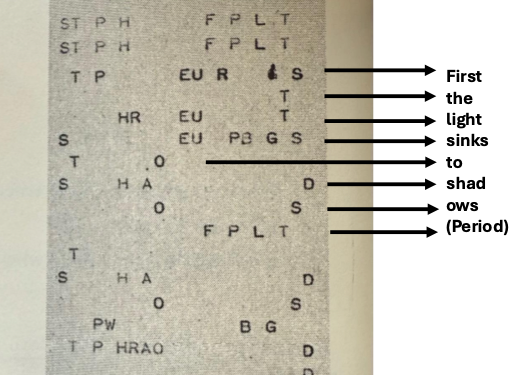
The source code for this strip of stenotype is the prose poem on the facing page. It begins: “First the light sinks to shadows. The shadows become flooded with broad washes of dark.” In a poem about vision, this is Wright’s ultimate gesture. Neither mere decoration nor documentation of a trial withheld, the facsimile is the poem itself, hiding in plain sight. By transposing the prose passages into glyphic versions of English, Wright pays homage to the court reporters to whom the book is dedicated while also smuggling linguistic images into visual images in a way that departs from the typographical shaping of concrete poetry. Yielding their utterances only under pressure and with patient looking, they are an expression of Deepstep’s demand to “Never avert the eyes.”
*
After a year in Hong Kong I returned to the United States. I spent one final summer swinging a hammer, framing houses for an uncle. Then I moved to New York to be closer to those institutions of art and literature I both revered and feared. I carried Deepstep with me as a kind of talisman, and in the years that followed I found its influence cropping up in my poetry in unexpected ways.
Deepstep was a hinge in Wright’s career. It was the first book she published with Copper Canyon, beginning a relationship that lasted the rest of her life. By and large, prior to Deepstep, Wright published collections of discrete poems. After Deepstep, she published book-length projects. Prior to Deepstep, her poetry’s political accents were gestural and periodic. After Deepstep, most of Wright’s books were documentary investigations with an unmistakable commitment to social justice. And Deepstep created a space of permission for a generation of poets like me to align with the rural avant-garde, to engage seriously with prevailing questions about abstraction, varieties of semantic reward, and the long shadow of Language poetry, even when writing about nail guns and goats.
Today when I teach Deepstep at my university in Saint Louis, many young poets find the book maddening, just as critics in New York and Chicago did twenty-five years ago. But occasionally I encounter a student from the rural Missouri Ozarks that are continuous with the Arkansas mountains where Wright was raised. When that student finds in Deepstep the kind of license that I did, I know it has done its job.

Ted Mathys is the author of four books of poetry including, most recently, Gold Cure (Coffee House Press, 2020). The Labors, a novel in verse that reimagines the labors of Herakles in contemporary American labor cultures, is forthcoming in 2027. The recipient of fellowships and awards from the National Endowment for the Arts, New York Foundation for the Arts, and Poetry Society of America, his poems have appeared or are forthcoming in BOMB, Boston Review, Conjunctions, Harvard Review, The Yale Review, and elsewhere. He lives in Saint Louis, where he is an associate professor of English at Saint Louis University and co-founder of the 100 Boots Poetry Series at the Pulitzer Arts Foundation. He is reading and enjoying Carbonate of Copper, by Roberto Tejada and On the Calculation of Volume (1), by Solvej Balle, translated by Barbara Haveland.