Who Do You Think You Are?: A Review of Camille Ralphs’s After You Were, I Am
In her grammatically adventurous debut, After You Were, I Am, Camille Ralphs hammers together an ambitiously conceived triptych—imitations of religious invocation, a modern medieval Spoon River Anthology, and a mystically wry daybook—all with the morbid torpor of William Dunbar’s “Lament For The Makers.” (His famous refrain, Timor Mortis conturbat me, would be replaced by O world, have mercy unto me.) Brush up on your Gospel of John and you’ll recall Jesus’s oddly phrased boast that “before Abraham was born, I am!” the theological point being that God never “was” but always already is. That reversed first foot, the immer schon of God’s supreme precedence (not even at the sentence level can Christianity take a back seat), models Ralphs’s old-yet-new approach to all three:
O gush of bushfire, O quintuple denim sea, sun pressing like a
button on us all,
O moon mirabilis, unmirrorable mirrorball, O, you, most
bottomless of wholes,
O arch as high as Maslow’s hierarchy, O I-wide eye, surround-
soundness of
oh what’s happened this time, yet O timeless bigtime, day that lasts
forever and a day
A decade ago for the Paris Review blog, Gabe Rivin’s “What Happened to O?” investigated the exclamation’s quiet demise. (The culprit? None other than Wordsworth.) Against T.S. Eliot’s mocking “O O O O,” Ralphs chooses to be moonstruck beneath “[t]he brite emurgencies of Heaven.” In “Book of Common Prayers,” the collection’s homaging first section, cats purr ergonomically and a version of the soul—Persian, what else?—flicks its tail to a totentanz. The ashen lip of an anachronistic cigarette is described as a “grey, scaled nodule” and the “fragrant” nails in a martyr’s hands are likened to cloves. (One wonders what that scent could be except the ferrous tang of blood.) These eighteen poems—after Saint Francis, Rumi, and John Donne, tough acts to follow—inherit the garrulousness of Geoffrey Hill, whose love of English trivia was deathly serious. Hill brooded over the OED like a Talmudist; Ralphs lacks Hill’s arrogance while keeping up the mass exemplification, in turn amending her own formulation that “you can’t spell ‘ego’ without e.g.”
Ralphs’s humble title designates herself as after, a clever modification that effectively denotes the historical subordination of every artist. For the post-Brexit reader, “Before you were, I am” likely brings to mind, if anything, not Christ informing the Jews of his eternal nature, but the greatest outburst in the annals of sports, bowler Pete Weber’s hilariously incomprehensible boast “Who do you think you are? I am!” That or Jonathan Safran Foer’s novel Here I Am. Whoever Ralphs thinks she is, cosplaying as those long dead—touchingly, the “you” meant in “after you were”—she has a knack for it Dickens would have admired, throwing her voice around like Sloppy miming the police. (Some of her commentary is a stand-in for the London of today, which after three hundred years has remained “more spit than shine.”) Guided by their Bibles, Donne and company were devilishly clever. With the internet generation likely to be lost in Christianity’s fine print, it is thrilling to watch Ralphs cannonball into such heady waters. Though a metaphysical poet, as reviewers seem legally obligated to point out, Ralphs uses five-pence expressions—“busy bee,” “salt of the earth,” “organ donor”—like the rest of us, and in a single poem, no less. Elsewhere, a dig at climate change (“we who lop the tops off trees to find heat’s name is / written in the wood”) will be lost amid her beautifully described “sundials of wild granite.”
From the second section on, dramatic monologues in which a slew of accused witches are revenged in propria persona, Ralphs astonishes. “Malkin: An Ellegy in 14 Spels” takes its title from a derogatory Britishism for a slovenly woman, but also scarecrows, raggedy mops, and cats; the term lives on in Macbeth’s Graymalkin, the first weird sister’s unforgettable feline familiar. As the learned magus writes, “I know you know I cannot spel”—the line between intention and accident vanishes into thin air when even “spell” is misspelled. (Like with the Lotus Eaters episode in Ulysses, where a love note to Leopold Bloom is mistyped as “I do not like that other world,” the extra letter borrowed from a later newspaper report where Bloom’s name is given as L. Boom, that wandering “l” crops up in “ellegy.”) Ralphs must have driven her copyeditor nuts given that vowels, like teeth, are missing left and right; consonants chatter in a “tchilll[ing] wynd” and a noisesome dog is hated for “yyammerringg.” Certain poems read like the burnt remains of a warlock’s grimoire.
What is a spell if not a kind of heretical wish? Ironically, it is the Latin Mass, with its litanies of hurt and long-winded petitions for spiritual aid, that complains the loudest. Ralphs, on the other hand, sees invocation as an opportunity to update these dusty topics. With “Come, my Motorway, my Equals Sign, my Higher Race,” After You Were, I Am’s opening address, I’m reminded, not of George Herbert, but the allusive clowning of Michael Robbins: “On Sabbath, on Slayer, on Maiden and Venom! / On Motorhead, Leppard, and Zeppelin, and Mayhem,” from Alien vs. Predator. Except when she’s punning on breakfast (“My daily bread and I are toast,” “Give good eggs a lucky break”) or poor Job, who, made to serve God, is “angry as a tennis racquet,” Ralphs’s sense of humor is as dry as a scriptorium, never mind whether racquets have emotions. The admirable thing about punning, assuming you’re susceptible to it, is how one sacrifices sense for joking’s sake: “I’m as silly as a window in my views,” quips Ralphs in the role of Ignatius Loyola, “as quick as sand in understanding.” But are windows silly? Is sand quick if it isn’t the sinking kind?
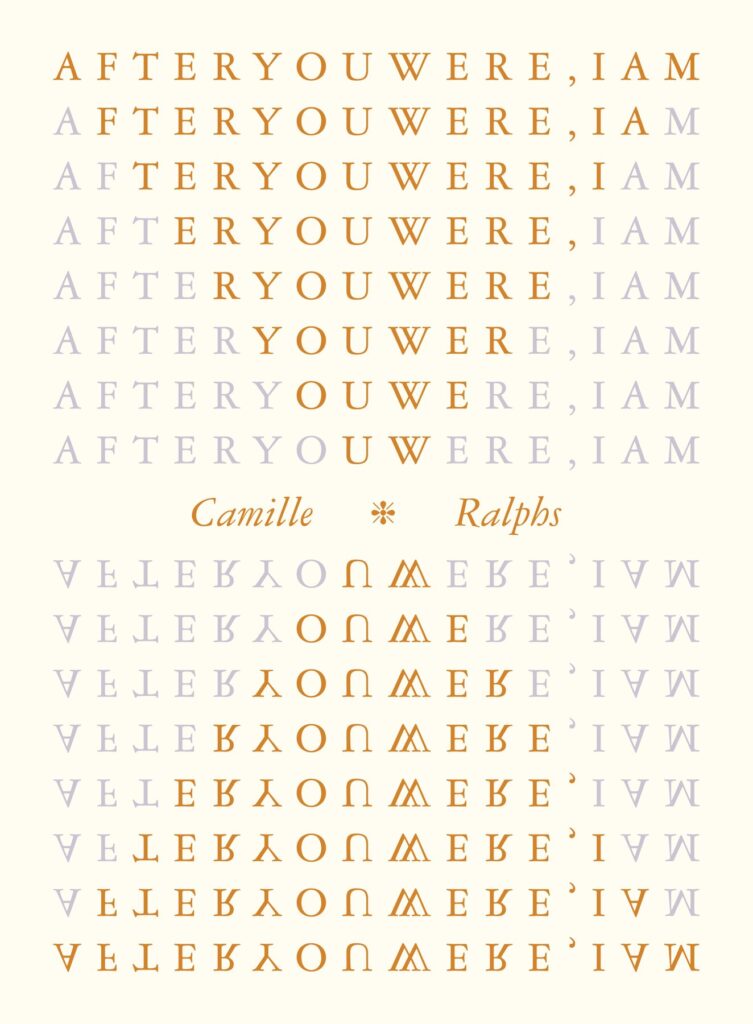
Appropriately, her cover art harkens to the angelic typography of Herbert’s “Easter Wings,” one of the most well-known examples of carmina figurata. (Though nowadays “Easter Wings” is laid out symmetrically and for easier reading, such that one no longer needs to rotate the pages in one’s hands, unfortunately this gives its paired stanzas more of an hourglass look.) Head to one side and tongue whimsically in cheek, Ralphs offsets a relatively small amount of her baroque work with references to cappuccinos, fixed-rate mortgages, and sugar daddies. This lasts half a tick before the reader is tossed under the “pessle” of her virtuosity:
A boy gnew me by a stonepit. He steemed
in th sun stone-kneeding, trimming trees like wicks;
his eyes were sofd as ash, and cities hymned
and chymneyed in the atlas of his sex.
I tricked in him,—unclocked all tocks, all ticks;
a debt that ploppd its anchor in my tchest—
nd 8 weeks fraille in rocking lihgt, I foamed
at the mouth like the sea. He ssuppd the moyst
unplundered of my underarm; he yessed,
impressed on me the braille of wouldlice
havocking the rocks.
I kept him at a cost:
he got with dogg my daughter, bent our howse
toward a future wigged with cirrus,
fingernail’d with hangman’s lime. I died in prison.
Ralphs’s anger, while meticulously built, is warmed by the rural humor of Seamus Heaney. Augustine of Hippo has heartburn and the only rosary is the spittle hanging from a suicidal nurse’s lips. Like any good know-it-all, Ralphs can’t help turning inside-out anything she lays sight on, such that pyramid schemes become “pyramids of schemes” and mells are pelled. And when, like the proverbial camel attempting to pass through a needle’s skinny eye—an “I-wide eye”?—John Dee, the legendary seventeenth-century natural philosopher who wouldn’t be out of place in The Alchemist or Nosferatu, vows to leave behind his earthly possessions, that includes his self-possession, too. “My Word,” the collection’s worldly-wise finale, only sounds like the cry of an irritated governess. As a version of the polymathic Dee’s journals, this diaristic caricature is as epic as it is inventive:
the unshallow pellicles of ice and skermishes with esquimaux, each shure
discovery: potatoes’ stringie bruses; what the inked men call
tobacco, we paetum. Every word for world is singular yet pleural
as the monarky; as the enemy within, without which
each vincible armie of Portugal, Spain…
But there is more. My scryer viewed the orb and mirror recently and saw
a world cleft into further states and states: more war,
more more. He didn’t have the language to explain.
After You Were, I Am is the sort of book where one immediately flips to the end pages. And, indeed, Ralphs includes copious notes—about twenty pages in total—which read less like the usual means of giving credit and more like a user’s manual. That is, although the Britannica is a tap away. The veracity of hers, a practice by no means limited to Ralphs, make Eliot’s semi-parodic notes to “The Waste Land” look like an antiquarian’s logbook. Per her interlocutor, Ralphs’s intention is to “pass these notes on to illiterate futures,” and they are entertaining. In her didactic “Notes on Spelling,” however, which has its own epigraph, Ralphs, breaking out the chalk and blackboard, schools us in the effects—curious effects, surprising even!—of etymological play, onomatopoeia, and dated orthography. Ralphs is smart, but that doesn’t mean her reader is dumb. Of course, accuracy must be of little concern when one remembers that “metaphysics” [metá phusiká] had simply been a filing term used by librarians to refer to those works of Aristotle shelved after the Physics. Popularized by Samuel Johnson in an essay on Abraham Cowley and reconsidered a century later by Eliot, the strange belatedness of metaphysical poetry, with its occult resemblances and “heterogeneous ideas [. . .] yoked by violence together,” might just be due for a renaissance. Safe to say, this book has enough discordia concors to kill a flea.
 Erick Verran is the author of Obiter Dicta (Punctum Books, 2021) and a PhD candidate at the University of Utah. His writing is forthcoming or has appeared in the Hopkins Review, the American Poetry Review, the Georgia Review, Gulf Coast, the Denver Quarterly, the Harvard Review, Literary Matters, the Los Angeles Review of Books, the Massachusetts Review, the Cleveland Review of Books, and many others. He lives in Salt Lake City, where he is currently reading True Grit, Einstein’s Dreams, and the Collected Poems of Ian Hamilton.