Constant Craving: Devin King Reviews Constantine Cavafy: A New Biography
Two major problems confront the biographer of the Greek modernist poet Constatine Cavafy. The first is squarely biographical: after a turbulent early life marked by emigration and the loss of money and class, the poet did very little except work in a government office in Alexandria, read, and write poetry. Nothing unusual there. Most artists have early lives that mark their interests and thereafter sink into the daily work of the imagination. Though sometimes there are frightful affairs or pills, sometimes grants or arguments about publishing, the biography becomes that of an artist in relation to their art: Henry James liked walking home from the club and saw figures appear and disappear into the streets of dark London and Ronald Johnson, against his father’s wishes, threw out the margarine in favor of butter. Gregory Jusdanis and Peter Jeffreys, the co-authors of Constantine Cavafy: A New Biography, supercharge this notion for—they hope—a popular reader. Rather than tell a straightforward story about Cavafy, they pronounce a series of facts grouped in five thematic chapter sets: The Cavafy Family, Alexandria, Friends, Living for Poetry, and Cultivating Fame.
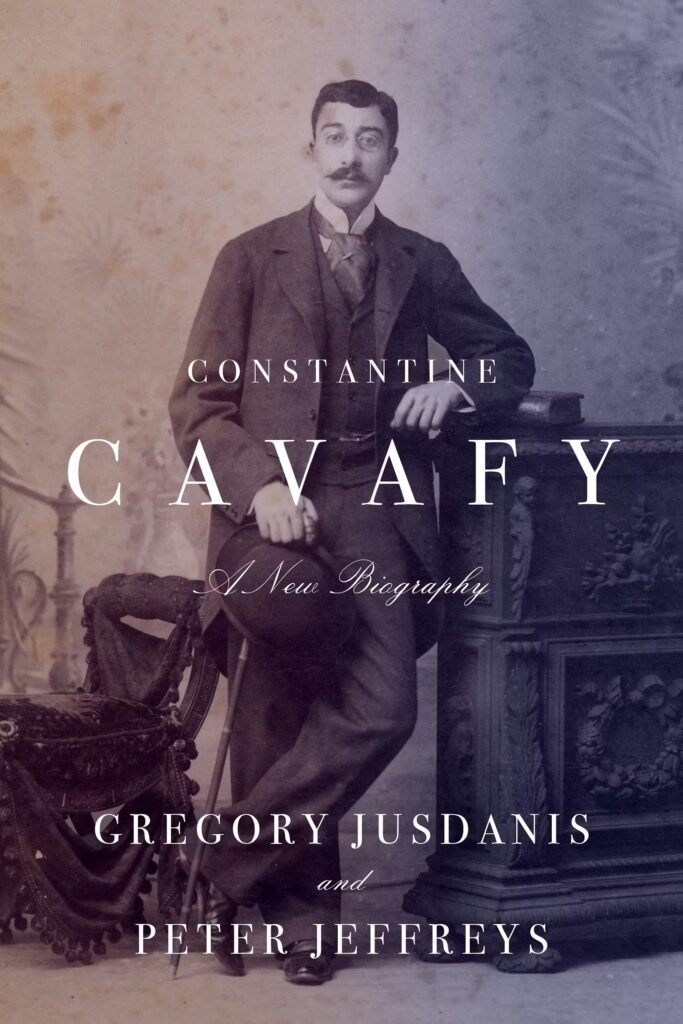
A long description of all the shops on the street Cavafy lived on, extended exegesis of the various letters we have (mostly sent to Cavafy, unfortunately), and a chapter made up almost entirely of stories from people who met him in his late-prime certainly does the trick. But, then, I also learned that Cavafy didn’t have electric light installed in his flat and so sat in the corner receiving people under candlelight from Robert Liddell’s biography from 1974. 200 pages shorter and mid-century British crisp. If you must read the Jusdanis and Jeffreys, the most groundbreaking section is Friends. One reason the reader may know Cavafy is due to his place in the canon as the gay European poet before Auden, and Friends gives us polite sketches of the gay, or at least philandering friends (not lovers!) that Cavafy had as a young man: “what we have in the landscape conjured by these letters [to Cavafy] is a world of pubs, sex, and gambling…”
It’s analysis like this that frustrates the indulgent reader’s advances. Whatever interest Jusdanis and Jeffrey’s themes have ties into the second problem facing the Cavafy biographer, an aesthetic one: difficulty in Cavafy’s poetry stems from references based on the poet’s interest in ancient (often) Byzantine history, yet the poet’s mastery of his new kind of gossipy, queer lyricism forecloses any need of a gloss for the non-academic in service of, I’ll rephrase the above, a landscape of queer desire and sex:
This epitaph for Marylos, son of Aristodimos,
who died in Alexandria a month ago,
was sent to me, his cousin Kimon, in my mourning.
It was sent by the author, a poet friend of mine,
sent because he knew I was related to Marylos—that’s all he knew.
My heart is full of sorrow over Marylos.
…
His premature death
completely wiped out any grudge…
any grudge I may have had against Marylos, even if
he did steal Ermotelis’ love away from me—
That’s Keeley and Sherrard’s translation of the torturously titled “Kimon, Son of Learchos, 22, Student of Greek Literature (In Kyrini).” Sure, the academic in me that wants to know if these folks existed, and who they might be, but, I dunno, I trust that that information’s out there in footnotes, and if I really need to know who Marylos is I can find it, but otherwise, the poem plainly directs. Jusdanis and Jeffreys do a good job of generally convincing you that Cavafy is basing his poems on real sources—but there is rarely any specific connection between the sources and the poems; a missed opportunity. In a non-academic book like this, one still wishes for a somewhat dedicated read of Cavafy’s poetry. Instead, it’s all in service of analysis like this:
In “A Young Man, Versed in Literature, in his Twenty-Fourth Year”, we are presented with a youth in his prime who is undone by his sexual addictions.
This is followed by a block quote of the poem in question and then we get “Another poem that fits into this category of hedonistic carousing is…” Other sections end with a thud: “No one knew if Constantine was a happy person. He certainly derived joy from his poems.” Authors like Jusdanis and Jeffreys—whose shared bonifides include so many monographs and committee appointments on Cavafy that one suspects they might be the poet himself—clearly have more chops than this; do FSG’s publishing algorithms churn in the background?
But perhaps the problem was inherited by Jusdanis and Jeffreys; Liddel’s book shares many of the same problems. A less conspiratorial answer is possible. Whether through fear of being outed, commitment to an anti-biographical poetics, or simple good manners, Cavafy was able to destroy much of his biography and recreate himself in his poems; any attempt at a book of this sort leaves a negative center pointing to the poems. The 400 pages didn’t altogether bore me but much of my time with the book was spent staring out the window, wishing I was reading Cavafy. I also do this while dishwashing to podcasts, which provide a similar solution to that old educational problem: how does one teach something one doesn’t really need to know?